
Archipsocus nomas
Gurney, 1939
webbing barklouse, web-spinning barklouse
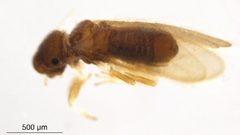
Archipsocus nomas is a web-spinning barklouse in the Archipsocidae. It forms dense communal silk webs on tree trunks and branches in the southeastern United States. The feeds on lichens, fungi, and organic debris. peak in summer and autumn, with long-winged females dispersing to establish new colonies.
Pronunciation
How to pronounce Archipsocus nomas: /ˌɑːrkɪpˈsoʊkəs ˈnoʊmæs/
These audio files are automatically generated. While they are not always 100% accurate, they are a good starting point.
Identification
Distinguished from other barklice by its dense sheet-like silk webs covering tree trunks and branches. Distinguished from the Archipsocus floridanus by geographic distribution (A. nomas: Atlantic and Gulf coasts from South Carolina to Texas; A. floridanus: Florida). Presence of long-winged dispersing females in summer-autumn characteristic. First instar nymphs identifiable by disproportionately wide .
Images
Habitat
Hardwood trees, particularly evergreen oaks (Quercus virginiana) and pecans (Carya illinoinensis). Also recorded on cabbage palms (Sabal palmetto), magnolias, and building exteriors. Gregarious colonies on trunks and large branches. Overwinters on evergreen trees where frost protection is greater.
Distribution
Southeastern United States: Atlantic coast from South Carolina southward, and Gulf Coast from Florida to Texas. GBIF records also indicate presence in Mexico, Bermuda, and Cuba.
Seasonality
laid in spring. increase through summer, peaking July–October. Long-winged females disperse during peak season to establish new colonies. Population decline begins early December; most individuals killed by winter frosts. as or late instar nymphs on evergreen trees.
Diet
Feeds primarily on small crustose lichens. Also consumes fungi, dead bark, and organic debris.
Host Associations
- Quercus virginiana - ; -laying siteevergreen southern live oak provides frost protection
- Carya illinoinensis - -laying sitehardwood tree selected for oviposition
- Sabal palmetto - cabbage palm provides frost protection
Life Cycle
Hemimetabolous development. laid singly or in groups in tree bark crevices, covered with debris for protection. Nymphs undergo multiple ; exact number unclear but inferred from A. floridanus: females 6 instars, males 5 instars. Wing pads appear in third instar females. Not parthenogenetic— only.
Behavior
Ecological Role
Consumer of lichens and fungi on tree bark. Webs provide incidental shelter for mites and springtails, though these are casual visitors with no mutualistic relationship. Serves as prey for spiders and ants. No damage caused to trees.
Human Relevance
Considered harmless to trees and buildings. Webs may be visually conspicuous but do not cause damage. No economic or medical significance.
Similar Taxa
- Archipsocus floridanus with similar ; distinguished by geographic restriction to Florida and known instar numbers (6 female, 5 male )
- Other Psocoptera (non-Archipsocidae)Most barklice do not produce extensive sheet webs; Archipsocus nomas distinguished by dense trunk-covering silk sheets
Misconceptions
Webs are sometimes mistaken for spider webs or signs of tree , but are harmless barklouse constructions. The insects are sometimes confused with aphids due to soft-bodied appearance, but possess chewing mouthparts and produce silk.
More Details
Silk production
Silk produced from glands in the mouth, finer than spider silk. Used to construct dense protective sheets on bark surfaces.
Polymorphism
Wing occurs in both sexes but is more pronounced in females, with long-winged forms serving as colony founders.