
Valenzuela flavidus
(Stephens, 1836)
yellow barklouse
Valenzuela flavidus is a barklouse in the Caeciliusidae, originally described as Psocus flavidus by Stephens in 1836 and later transferred to Valenzuela by Navás in 1924. The species exhibits complex structure with both sexual and modes: European populations are all-female and triploid, reproducing via , while North American populations contain males and appear to be with . This cryptic diversity within the has been confirmed through genomic studies.
Pronunciation
How to pronounce Valenzuela flavidus: /vaˈlɛnt͡sʊɛla ˈflavɪdʊs/
These audio files are automatically generated. While they are not always 100% accurate, they are a good starting point.
Identification
Distinguished from by yellowish-black body coloration. Accurate -level identification within Valenzuela requires examination of genitalic structures and wing venation patterns. European can be identified as parthenogenetic by all-female composition, while North American populations may contain males. Genetic analysis or cytogenetic examination is required to distinguish ploidy levels between populations.
Images
Appearance
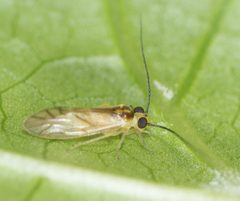
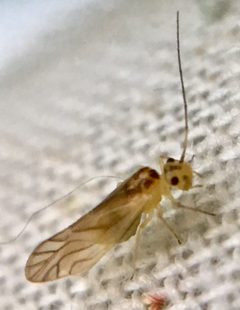
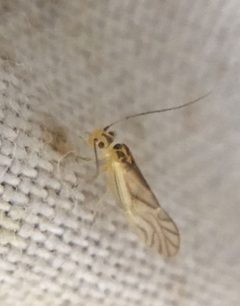
Yellowish-black coloration. As a member of Caeciliusidae, individuals are small, soft-bodied insects with long , broad , and reduced wing venation typical of barklice.
Habitat
Found on trees and shrubs where it feeds on microflora growing on bark and leaves. Documented from a broad range of woody plants including alder, ash, beech, birch, blackthorn, broom, elder, elm, hawthorn, hazel, ivy, laurel, oak, pine, poplar, sallow, spindle, sycamore, sea buckthorn, willow, berberis, guelder rose, and rhododendron. Also recorded feeding on rowan berries.
Distribution
Widespread across Europe including United Kingdom, Ireland, Austria, Azores, Belgium, Bulgaria, Canary Islands, Croatia, Denmark, Finland, France, Germany, Greece, Hungary, Italy, Latvia, Luxembourg, Norway, Poland, Portugal, Romania, Spain, Sweden, Switzerland, and the Netherlands. Also present in the Near East and North America. European and North American represent divergent lineages with different reproductive modes.
Diet
Feeds on microflora growing on trees and shrubs, including lichens, , fungal spores, and other organic detritus on bark and leaf surfaces. Has been observed feeding on rowan berries.
Life Cycle
Development includes , nymph, and stages typical of Psocodea. European reproduce via with triploid females. North American populations appear to reproduce sexually with males and females present.
Behavior
European exhibit obligate with no males produced. North American populations show with male presence.
Ecological Role
Contributes to nutrient cycling through consumption of microflora on vegetation surfaces. Acts as a decomposer in forest and shrubland by processing organic material on bark and leaves.
Similar Taxa
- Valenzuela subflavusSimilar yellowish coloration and body form; distinguished by subtle differences in wing venation and genitalic . Both were originally described by early 19th century authors and retained in Valenzuela following revisionary work.
- Other Valenzuela speciesMany share similar bark-dwelling habits and general ; accurate identification requires examination of diagnostic characters including wing markings, antennal segment counts, and male/female genitalia.
More Details
Taxonomic History
Originally described as Psocus flavidus by Stephens in 1836 in 'Illustrations of British Entomology'. Transferred to Valenzuela by Navás in 1924 when he erected that . Unlike several Navás himself placed in Valenzuela, which were later synonymized or transferred by Meinander (1979) and Lienhard and Smithers (2002), the placement of V. flavidus has been maintained.
Cryptic Species Complex
Genomic studies using Illumina whole sequencing have revealed that V. flavidus comprises divergent with different ploidy levels and reproductive modes. European populations are triploid and parthenogenetic, while North American populations are and sexual. This suggests the potential for cryptic speciation within the current taxonomic concept of V. flavidus.
Ploidy and Reproduction
Cytogenetic and genomic evidence demonstrates that European all-female are triploid (3n), while North American populations containing males are estimated to be (2n). This difference in ploidy level correlates with reproductive mode: in Europe versus in North America.
Sources and further reading
- BugGuide
- Wikipedia
- iNaturalist taxon
- NCBI Taxonomy
- Catalogue of Life
- Grasshoppers of Colorado
- Grasshoppers of Colorado
- Cuckoo Combo: Re-Classification Makes Bombus flavidus World's Most Widespread Bumble Bee
- Five new species of snail-sucking snakes | Blog
- Illumina whole genome sequencing indicates ploidy level differences within the Valenzuela flavidus ( Psocodea : Psocomorpha : Caeciliusidae ) species complex