
Colpocephalum
Nitzsch, 1818
Colpocephalum is a of chewing lice (order Psocodea: suborder ) comprising approximately 135 of avian . The genus was established by Christian Ludwig Nitzsch in 1818, with Colpocephalum zebra Burmeister, 1838 designated as type species by ICZN ruling in 1955. Species parasitize birds across at least 13 orders, representing an unusually broad distribution among . Molecular phylogenetic studies have revealed that Colpocephalum as traditionally circumscribed is not monophyletic, with several distinct lineages corresponding to previously described subgenera or genera.
Pronunciation
How to pronounce Colpocephalum: //ˌkɒlpəˈsɛfələm//
These audio files are automatically generated. While they are not always 100% accurate, they are a good starting point.
Identification
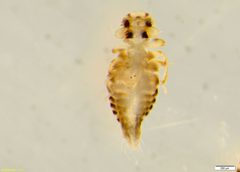
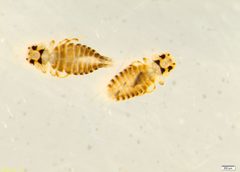
Colpocephalum are distinguished from other amblyceran by their characteristic "rapid running" , enabling them to escape preening and occupy exposed body regions. Specific identification relies on morphological features of the , , and abdominal chaetotaxy; species-level keys exist for particular host-associated groups such as those on Pelecaniformes. The has been historically confused with Actornithophilus and related genera, necessitating careful examination of for accurate identification.
Images
Habitat
Strictly ectoparasitic on avian ; occupies exposed body regions including breast, back, anal area, and feather quills. Specific microhabitat varies by host and species. In laboratory conditions, Colpocephalum turbinatum has been maintained at 35±1°C and 75-82% relative humidity on feather diet.
Distribution
distribution following avian ranges. Documented from Europe, Africa, Asia (temperate and tropical regions), and Australasia. Individual distributions are constrained by host specificity, though some species such as C. turbinatum are unusually widespread, parasitizing at least 53 bird species across Falconiformes, Strigiformes, and Columbiformes.
Diet
Feather-feeding (pterophagy); crop contents contain feather barbules as primary food source. Colpocephalum turbinatum has been observed consuming epidermal tissue and, in laboratory colonies, engaging in on and nymphs. Not haematophagous: microscopic examination of C. turbinatum found no blood in crop contents and no morphological structures for piercing skin.
Host Associations
- Aves (birds) - At least 13 orders including Pelecaniformes, Falconiformes, Strigiformes, Columbiformes, Ciconiiformes
Life Cycle
: → three nymphal instars → . For C. turbinatum under laboratory conditions (35±1°C, 75-82% RH): egg incubation 5.37±0.67 days; nymphal instars I-III lasting 5.04±0.65, 5.12±0.89, and 5.0±0.57 days respectively. Adult female longevity (13.04±3.67 days) exceeds male longevity (9.6±2.87 days). : 0.63 egg/day/female under laboratory conditions.
Behavior
Rapid running locomotion allows escape from preening, permitting occupation of exposed body regions unavailable to slower . of C. turbinatum exhibit in laboratory colonies, consuming and up to 80% of nymphs.
Ecological Role
impacting condition; heavy of C. turbinatum can remove most vent region feather fluff and damage feathers, reducing host flying capability. genetic studies using microsatellite markers suggest potential for understanding transmission dynamics within and between host social groups.
Human Relevance
Potential pest of domestic pigeons; C. turbinatum can cause feather damage and reduced performance in carrier and racing pigeons. Subject of cophylogenetic research investigating - evolutionary relationships. Molecular markers developed for C. turbinatum have applications in studying and transmission dynamics in conservation contexts (e.g., Galápagos hawk).
Similar Taxa
- ActornithophilusHistorically confused with Colpocephalum; C. ochraceum is congeneric with Actornithophilus uniseriatum, the type of Actornithophilus. Molecular supports recognition of distinct lineages within the Colpocephalum complex corresponding to previously described including Actornithophilus.
- DegeeriellaBoth are feather-feeding infesting birds of prey, but cophylogenetic analysis reveals no correlated evolutionary patterns, indicating distributions shaped by different processes. Degeeriella is in suborder Ischnocera rather than .
Misconceptions
Amblyceran including Colpocephalum have been assumed to exhibit varying degrees of haematophagy; however, microscopic examination of C. turbinatum crop contents found only feather barbules and epidermal tissue with no evidence of blood consumption, and no piercing mouthpart structures were detected by SEM.
More Details
Taxonomic instability
Molecular phylogenetic analysis (cophylogenetic study, 2016) demonstrated that Colpocephalum is not monophyletic. The 'Colpocephalum complex' contains several lineages restricted to particular orders, corresponding to previously described currently treated as subgenera. Host order, host , and biogeographic region show significant phylogenetic signal. Maddison-Slatkin tests and PARAFIT analysis revealed significant congruence between host and within the complex.
Type species designation history
The type designation involved complex nomenclatural history. Strict application of ICZN Code would have made Liotheum (Colpocephalum) ochraceum the type species as the only available name in Nitzsch's 1818 original circumscription. Louis Georges Neumann's 1906 designation of 'L. (C.) zebra' was validated by ICZN Opinion 342 (1955) through Plenary Powers to avoid 'disastrous confusion,' with Colpocephalum zebra Burmeister, 1838 becoming the valid type species.
Sources and further reading
- BugGuide
- Wikipedia
- GBIF taxonomy match
- iNaturalist taxon
- NCBI Taxonomy
- Catalogue of Life
- THE COLPOCEPHALUM (MALLOPHAGA: MENOPONIDAE) OF THE PELECANIFORMES
- In vitro biology of pigeon louse Colpocephalum turbinatum (Amblycera: Phthiraptera)
- A New Colpocephalum (Mallophaga: Menoponidae) from Daptrius ater
- Nature of crop contents of an amblyceran pigeon louse, Colpocephalum turbinatum (Phthiraptera: Insecta)
- A NEW HOST FOR COLPOCEPHALUM INFUSCATI PRICE & EMERSON, 1967 (AMBLYCERA: MENOPONIDAE) FROM THE STATE OF RIO GRANDE DO SUL, BRAZIL
- Designation of neotype forColpocephalum ThoracicumKellogg and Paine, 1914 (Phthiraptera : Insecta) with some remarks on distribution
- A new species of Colpocephalum (Phthiraptera) on Threskiornis (Aves) from Aldabra
- Eight polymorphic microsatellite markers isolated from the widespread avian louse Colpocephalum turbinatum (Phthiraptera: Amblycera: Menoponidae)
- Cophylogenetic analysis of lice in theColpocephalumcomplex (Phthiraptera: Amblycera)