
Isoperla marmorata
(Needham & Claassen, 1925)
red stripetail
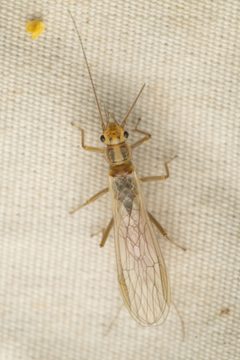
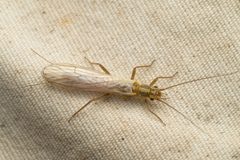
Isoperla marmorata, commonly known as the red stripetail, is a of green-winged in the Perlodidae. It was described by Needham and Claassen in 1925. The species is found in western North America, with documented occurrences in California, Nevada, Oregon, and Washington. Like other perlodid stoneflies, it belongs to the order Plecoptera, an ancient group of aquatic insects with .
Pronunciation
How to pronounce Isoperla marmorata: /ˌaɪsoʊˈpɜːrlə ˌmɑːrməˈrɑːtə/
These audio files are automatically generated. While they are not always 100% accurate, they are a good starting point.
Identification
The combination of green wings, marbled body pattern, and red striping on the tail distinguishes this from other western North American perlodids. Specific identification requires examination of male genitalia and other fine morphological details. It may be confused with other Isoperla species, particularly sympatric western species such as Isoperla quinquepunctata or Isoperla petersoni, from which it differs in details of abdominal color pattern and genitalic structure.
Images
Habitat
Aquatic larval stages inhabit cool, well-oxygenated streams and rivers—typical for Perlodidae. Specific microhabitat preferences (e.g., substrate type, flow regime) have not been documented for this . are found near water bodies where occurs.
Distribution
Western North America: documented from California, Nevada, Oregon, and Washington. The distribution appears restricted to the Pacific states and adjacent interior western regions.
Similar Taxa
- Isoperla quinquepunctataOverlapping western North American distribution; similar green-winged perlodid ; differs in abdominal spot pattern (five spots vs. marbled pattern).
- Isoperla petersoniSympatric in parts of western North America; similar size and general appearance; requires genitalic examination for reliable separation.
- Other Perlodidae genera (e.g., Cultus, Helopicus)Share green-winged appearance and aquatic ; differ in body proportions, wing venation, and abdominal patterning.
More Details
Taxonomic note
The specific epithet "marmorata" refers to marbled or mottled patterning. The "red stripetail" emphasizes a different diagnostic feature (abdominal tip coloration), suggesting that both pattern elements may be useful for field recognition.
Data limitations
This has only 6 observations in iNaturalist as of source date, indicating it is infrequently encountered or underreported. Published biological studies specific to this species appear sparse.