
Isoperla
Banks, 1906
stripetails, springflies
Species Guides
16- Isoperla bilineata(Two-lined Stripetail)
- Isoperla davisi(Alabama stripetail)
- Isoperla dicala(Sable Stripetail)
- Isoperla holochlora(Pale Stripetail)
- Isoperla lata(Dark Stripetail)
- Isoperla marlynia(Midwestern Stripetail)
- Isoperla marmorata(red stripetail)
- Isoperla montana(Montane Stripetail)
- Isoperla namata(Ozark stripetail)
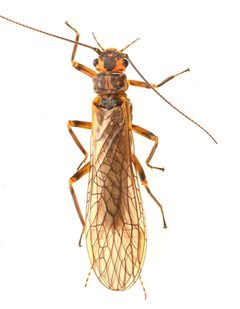
Isoperla is a of perlodid stoneflies distributed across the Palaearctic and Nearctic regions. The genus belongs to the Isoperlinae and is commonly known as stripetails or springflies. exhibit through substrate-borne drumming, with males producing species-specific calls to locate females. Larvae are primarily aquatic and inhabit running water environments, though specific preferences vary among species. The genus is taxonomically diverse with numerous species in the Balkans and other mountain regions.


Pronunciation
How to pronounce Isoperla: /ˌaɪsoʊˈpɜːrlə/
These audio files are automatically generated. While they are not always 100% accurate, they are a good starting point.
Identification
males possess eversible penial lobes with -specific arrangements of and that serve as primary diagnostic characters; SEM examination of is standard for species delimitation. Larvae typically have pointed paraprocts, though some species (e.g., I. vevcianensis) exhibit blunt paraprocts, representing an exception to this generic character. surface structure and chorionic sculpturing provide additional diagnostic features. Species-specific drumming call patterns—characterized by distinct inter-tap intervals and temporal patterns—can be used for identification of living males in the field.
Images
Habitat
Running freshwater environments including streams, rivers, springs, and spring brooklets; specific microhabitat preferences vary by . Some species occupy large shifting gravel rivers at low altitudes (e.g., I. vjosae in Albania), while others are restricted to cold spring-fed headwaters (e.g., I. orobica in Alpine springs of Switzerland).
Distribution
Holarctic distribution encompassing Palaearctic and Nearctic regions. In the Palaearctic: widespread across Europe including Balkan Peninsula (Albania, Montenegro, Greece, Bulgaria, Macedonia, Bosnia and Herzegovina), Switzerland (southern Alpine slopes in Valais, Ticino, Grisons), Siberia, Russian Far East, China, and Mongolia. In the Nearctic: recorded from western North America (Washington, Oregon) and eastern regions (Alabama, Wisconsin, Alberta). Numerous regional endemics documented, particularly in the Balkans.
Life Cycle
Aquatic larval stage followed by terrestrial stage. Larvae develop in freshwater environments; specific developmental duration varies by and environmental conditions. timing appears to vary among species, with some autumn-emerging species documented (e.g., I. autumnalis). Adults are short-lived and do not feed.
Behavior
Males produce substrate-borne vibrational signals (drumming) by rhythmically tapping the against the substrate; these calls function in mate location and recognition as pre-mating isolation mechanisms. Females respond with species-specific answer calls. Call parameters vary among species: documented inter-tap intervals range from approximately 0.8 seconds (I. quinquepunctata) to 3.5 seconds (I. fulva). Some species exhibit two-part male calls with distinctive female two-tap answers (e.g., I. sordida).
Human Relevance
Some are threatened by river regulation and hydroelectric development; I. vjosae is specifically endangered by a proposed dam on the Vjosa River in Albania. Larvae are used as bioindicators of water quality in freshwater biomonitoring programs due to their sensitivity to alteration. The of I. grammatica has been sequenced, providing genomic resources for research.
Similar Taxa
- IsogenusBoth belong to Perlodidae and share general stripetail ; distinguished by details of male genitalia and larval characters
- Perlodidae (other genera)Isoperlinae placement distinguished by combination of penial lobe structure, larval paraproct shape, and drumming characteristics
Sources and further reading
- BugGuide
- Wikipedia
- GBIF taxonomy match
- iNaturalist taxon
- NCBI Taxonomy
- Catalogue of Life
- Isoperla vjosae sp. n., a new species of the Isoperla tripartita group from Albania (Plecoptera: Perlodidae)
- Drumming Behavior of Four Western Nearctic Isoperla (Plecoptera) Species1
- Balkanian species of the genus Isoperla Banks, 1906 (Plecoptera: Perlodidae)
- Nymphs of the genus Isoperla Banks (Plecoptera, Perlodidae) from the Eastern Palaearctic Region
- Figure 3 from: Lubini-Ferlin V, Teufl P, Novotny C, Vuataz L (2023) Description of the larva of Isoperla orobica Ravizza, 1975 (Plecoptera, Perlodidae), with notes on ecology and distribution in Switzerland. Alpine Entomology 7: 205-212. https://doi.org/10.3897/alpento.7.109021
- Notes on the Life History and Ecology of Isoperla clio (Newman) and Isogenus decisus Walker (Plecopter: Perlodidae)
- Loss of a larval generic character: an interesting and new description for Isoperla vevcianensis Ikonomov, 1980 (Plecoptera: Perlodidae) with updated adult characters
- Description of the larva of Isoperla orobica Ravizza, 1975 (Plecoptera, Perlodidae), with notes on ecology and distribution in Switzerland
- Life cycle and production of Isoperla signata (Banks) in a Central Wisconsin trout stream
- The genome sequence of the Common Yellow Sally, Isoperla grammatica (Poda, 1761) (Plecoptera: Perlodidae).