
Agnetina flavescens
(Walsh, 1862)
Midwestern Stone
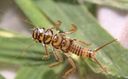
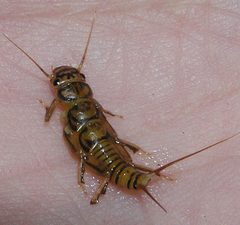
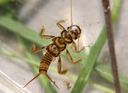
Agnetina flavescens, commonly known as the midwestern stone, is a in the Perlidae. It is native to North America and has been documented in several midwestern and southeastern US states. As a member of the common stoneflies, it inhabits freshwater systems where its aquatic nymphs develop. The species was originally described as Perla flavescens by Walsh in 1862 before being transferred to the Agnetina.
Pronunciation
How to pronounce Agnetina flavescens: /æɡˈnɛtɪnə fləˈvɛskɛnz/
These audio files are automatically generated. While they are not always 100% accurate, they are a good starting point.
Identification
As a Perlidae , typically have two pairs of membranous wings with complex venation, long filamentous , and chewing mouthparts. -level identification within Agnetina requires examination of genitalia and wing characteristics. The specific epithet 'flavescens' suggests yellowish coloration, though this cannot be confirmed from available sources.
Images
Habitat
Freshwater lotic environments, including streams and rivers. Specific microhabitat preferences within these systems are not documented.
Distribution
Documented occurrences in Alabama, Arkansas, Georgia, Illinois, and Indiana. Distribution appears concentrated in the midwestern and southeastern United States.
Life Cycle
As with all Plecoptera, development includes , aquatic nymph, and terrestrial stages. Nymphs are aquatic and undergo multiple instars before emerging. Specific duration of life stages for this is not documented.
Ecological Role
Nymphs function as or in freshwater , processing organic matter and serving as prey for fish and other aquatic organisms. are primarily reproductive and do not feed extensively.
Similar Taxa
- Other Agnetina species-level morphological similarities require careful examination of male genitalia and wing venation patterns for definitive separation.
- Other Perlidae genera (e.g., Perla, Acroneuria)-level characteristics overlap; -level identification depends on detailed morphological analysis of diagnostic structures.
More Details
Original description
First described as Perla flavescens by Walsh in 1862, later transferred to Agnetina.
Sources and further reading
- BugGuide
- Wikipedia
- GBIF taxonomy match
- iNaturalist taxon
- NCBI Taxonomy
- Catalogue of Life
- Bembicid Holdings | Entomology Research Museum
- How a Hydrogen Isotope Reveals a Dragonfly's Long-Distance Journey
- This Dragonfly's Migratory Route is Even Longer than the Monarch Butterfly's
- GBCT Beetle #5: Crossidius coralinus monoensis | Beetles In The Bush
- Insect Migration (Part 1) - Buglife Blog - Buglife
- Mudo Pryfed (Rhan 1) - Buglife Blog - Buglife