
Chloroperlidae
Okamoto, 1912
Green Stoneflies, Green Sallies, Yellow Sallies, Yellow Sallflies
Subfamily Guides
2is a of stoneflies comprising over 200 across 22 , commonly known as green stoneflies for their characteristic yellowish-green to green coloration. range from 6–20 mm in body length and are distinguished by relatively short , slender labial palps, and wings pads that remain parallel to the body midline. The family exhibits hemimetabolous development with , nymph, and adult stages but no pupal stage. Nymphs are aquatic inhabitants of cold, clean streams and rivers across five continents, where their sensitivity to pollutants makes them important bioindicators of water quality. Adults are primarily terrestrial, dwelling in riparian vegetation near water bodies with a brief lifespan focused on .
Pronunciation
How to pronounce Chloroperlidae: /ˌklɔːroʊˈpɜːrɪlaɪdiː/
These audio files are automatically generated. While they are not always 100% accurate, they are a good starting point.
Identification
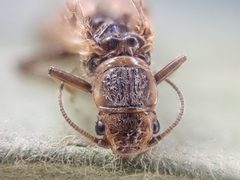
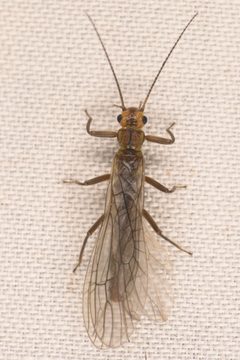
Distinguished from other by the combination of: short relative to length; slender labial palps; wing pads parallel to midline (not divergent); and absence of distinct thoracic pigment patterns. The green to yellow coloration separates them from many darker stonefly families. Nymphs can be identified by their nearly parallel wing pads and short legs. Within Plecoptera, lack the robust build and patterned of Perlidae, and differ from Perlodidae in cerci proportions and wing pad orientation.
Images
Appearance
are small to medium-sized stoneflies, 6–20 mm in length, with yellowish-green to green or sometimes yellow coloration. The body and wings become oval-shaped in adulthood. Diagnostic features include: lack of distinct pigment patterns on the ; relatively short compared to length; slender labial palps; wing pads in nymphs that are not divergent from the body midline (remaining nearly parallel); and short legs. Nymphs have brown to yellow bodies with almost-parallel hindwing pads.
Habitat
Nymphs inhabit the benthic zone of cold streams and rivers, particularly stony substrates in mountain streams and lakes. Some occupy the hyporheic zone (subsurface flow beneath stream beds), emerging only before . Adults occupy the riparian zone, dwelling on rocks, debris, and vegetation near water bodies. The shows low to pollutants and requires high water quality.
Distribution
Predominantly Holarctic in distribution. Approximately 95 in North America, 89 in Asia, 19 in Europe, 2 in Central America, and 1 in Africa. Zoogeographically: 95 species in the Nearctic region, 20 in the Palaearctic, 2 in the Neotropical, with representation across four zoogeographical regions total.
Seasonality
Nymphs develop for approximately one year. emerge in spring or summer. Males typically emerge earlier than females. Adult lifespan lasts 1–4 weeks.
Diet
Nymphs are primarily , consuming fine particulate organic matter, coarse particulate organic matter, and unicellular organisms. As nymphs mature, they become increasingly , feeding on larvae, larvae, caddisfly larvae, and other larvae. Carnivorous nymphs possess mouthparts adapted for grasping and penetrating prey, while herbivorous forms have scraping and grinding mouthparts. generally do not feed, though some with extended adult lifespans continue limited feeding.
Life Cycle
Hemimetabolous development with three stages: , nymph, and ; no pupal stage. Females deposit egg sacs into water by dropping above water, releasing from banks, or depositing on gravel substrates. Eggs may enter for 3–12 months under unfavorable conditions, or hatch within 2–3 weeks to several months. Nymphs undergo 12–23 instars over approximately one year, developing wing pads progressively. Final produces winged adults that emerge in spring or summer. Adult stage lasts 1–4 weeks, focused on .
Behavior
males produce -specific vibrational signals by striking their against substrates (drumming) to attract females. Females respond with identical signals, enabling mate location. Males that emerge early are larger and more successful at mating with multiple females (polygynous mating system). Adults often aggregate in swarms near vegetation at water edges. Some species exhibit "fly-tremulate-search" or "rock to rock" mate-searching patterns. Nymphs of some species (e.g., Suwallia pallidula) remain in hyporheic zone until .
Ecological Role
Important bioindicators of high water quality due to sensitivity to pollutants. Serve as prey for fish and in freshwater . Nymphs contribute to nutrient cycling through consumption of organic matter and on other aquatic insects. provide food for terrestrial .
Human Relevance
Popular as live for trout fishing, where they are known as "yellow sallies" or "yellow sallflies." Used by anglers to match hatch conditions. Their presence indicates healthy, unpolluted aquatic valuable for fisheries and water resource management.
Similar Taxa
- PerlidaeLarger, more robust body with distinct thoracic pigment patterns and longer ; nymphs have divergent wing pads.
- PerlodidaeSimilar size range but differ in wing pad orientation and proportions; often have more patterned bodies.
- NemouridaeGenerally smaller with different wing venation and body proportions; nymphs often have different gill arrangements.
Sources and further reading
- BugGuide
- Wikipedia
- GBIF taxonomy match
- iNaturalist taxon
- NCBI Taxonomy
- Catalogue of Life
- The eastern Nearctic species Rasvena terna (Frison, 1942) (Plecoptera, Chloroperlidae)
- Systematics of the Stonefly Tribe Suwalliini Surdick and Behavioral Studies of Selected Species in the Stonefly Families Chloroperlidae and Perlidae
- Review of the genus Suwallia (Plecoptera: Chloroperlidae) from China with description of Suwallia jihuae sp. nov. from Sichuan Province
- A new Siphonoperla species from the Eastern Alps (Plecoptera: Chloroperlidae), with comments on the genus
- Life Cycles of Sweltsa Species (Plecoptera: Chloroperlidae) in a Small Mountain Stream
- Egg development of the stoneflies Siphonoperla burmeisteri(Chloroperlidae) and Dinocras cepùnalotes(Perlidae)
- Contribution to the knowledge of Siphonoperla in Europe (Plecoptera: Chloroperlidae): Siphonoperla korab sp. n.
- Synopsis of Chinese Alloperla Banks, 1906 (Plecoptera, Chloroperlidae), with description of a new species.