
Allocapnia vivipara
(Claassen, 1924)
Shortwing Snowfly, short-wing snowfly
Allocapnia vivipara, commonly known as the shortwing snowfly, is a of in the Capniidae. It is native to North America and has been recorded from multiple states in the central United States. The species was originally described as Capnella vivipara by Claassen in 1924 before being transferred to Allocapnia. As a winter stonefly, it belongs to a group adapted to cold-season activity.
Pronunciation
How to pronounce Allocapnia vivipara: /æloʊˈkæpniə ˌvaɪvɪˈpærə/
These audio files are automatically generated. While they are not always 100% accurate, they are a good starting point.
Identification
Distinguished from other by the short, abbreviated wings of that fail to reach the apex. Separated from other Allocapnia by genitalic characters and geographic distribution; precise diagnostic features require keys. The 'shortwing snowfly' directly references the diagnostic wing condition.
Images
Appearance
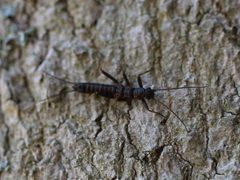
A . Like other members of Capniidae, are characterized by reduced or short wings that do not extend to the tip of the , a trait reflected in the 'shortwing snowfly'. Body size is small relative to other . Specific coloration and detailed morphological features require direct specimen examination.
Habitat
Associated with freshwater stream environments typical of stoneflies. Specific microhabitat preferences (e.g., stream size, substrate type, flow regime) are not documented in available sources.
Distribution
Recorded from North America, specifically the central United States. Confirmed state records include Arkansas, Illinois, Indiana, Iowa, and Kansas. The full extent of its range may be broader than currently documented.
Seasonality
As a 'winter stonefly' ( Capniidae), are active during cold months, typically emerging and mating in winter or early spring when temperatures are near freezing. Exact period varies by latitude and local climate conditions.
Life Cycle
Undergoes (hemimetabolous development) typical of Plecoptera, with , nymph, and stages. Nymphs are aquatic and develop in streams. Specific details of development time, voltinism (number of per year), and nymphal requirements are not documented.
Ecological Role
Nymphs function as or grazers in stream , contributing to nutrient cycling and serving as prey for fish and other aquatic . are primarily reproductive and do not feed extensively.
Similar Taxa
- Other Allocapnia speciesCongeneric share the short-winged condition and require genitalic examination or geographic range for reliable separation
- Other Capniidae generaAll winter stoneflies have reduced wings; separation requires examination of wing venation, body proportions, and genitalic structures
- Taeniopterygidae (winter stoneflies)Another of winter-active stoneflies with somewhat reduced wings; distinguished by different wing venation and body form
More Details
Taxonomic history
Originally described as Capnella vivipara by Claassen in 1924, later transferred to Allocapnia. The basionym reflects historical uncertainty in capniid generic limits.
Observation frequency
The has accumulated over 700 observations on iNaturalist, indicating it is encountered with moderate frequency by naturalists in its range, though it may be under-recorded due to winter activity period.