
Peruphasma schultei
Conle & Hennemann, 2005
Black Beauty Stick Insect, Golden-eyed Stick Insect
Peruphasma schultei is a critically endangered phasmid to a restricted area of less than 5 hectares in the Cordillera del Condor region of northern Peru. The species exhibits distinctive aposematic coloration with a black body, yellow , and red wings in . It is the first species in its known to possess tegmina and alae. Due to its unusual appearance, it has become popular in the pet trade and is now widely bred in captivity, though wild continue to decline.
Pronunciation
How to pronounce Peruphasma schultei: /ˌpɛruˈfæzmə ˈʃʊlt.aɪ/
These audio files are automatically generated. While they are not always 100% accurate, they are a good starting point.
Identification
Distinguished from other Peruphasma by the presence of bright red wings in —the first species in the with tegmina and alae. The combination of black body, yellow , and red wing pads separates it from cryptically colored stick insects. When disturbed, adults spray a defensive liquid from glands at the rear of the , a behavioral cue supporting identification.
Images
Appearance
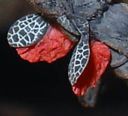
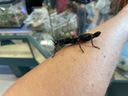
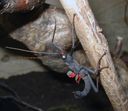
A large and compact phasmid with striking coloration. Females reach 5.5 cm in length, noticeably larger than males at 3.8–4.3 cm. The body is uniformly black with bright yellow and red-brown mouthparts. possess bright red wings ( tegmina and alae), a unique feature within the . The overall appearance is aposematic rather than cryptic.
Habitat
Found in grassland and forest in mountainous terrain, specifically on volcanoes and mountains in the Cordillera del Condor. The occurs at locations such as Cerro Casapita. It does not tolerate pasturelands or converted agricultural land.
Distribution
to northern Peru, specifically the Cordillera del Condor region. Known only from an area of less than 5 hectares. The inhabits at least three protected areas originally established for the Marañon Poison Dart Frog.
Diet
In the wild, feeds on Schinus plants. In captivity, accepts privet (Ligustrum), Aucuba japonica, and honeysuckle (Lonicera).
Host Associations
- Schinus - wild food plantprimary in natural
Life Cycle
have been described. Brief breeding information is documented in the original description.
Behavior
When disturbed, spray a defensive liquid from glands located at the rear of the . This secretion can irritate skin and . The ' aposematic coloration (black body, yellow eyes, red wings) likely serves as a warning signal associated with this chemical defense.
Human Relevance
Popular in the international pet trade due to its unusual coloration. Widely bred in captivity since its discovery. Listed as Critically Endangered on the IUCN Red List (last assessed May 2018). Named in honor of Rainer Schulte, who collected the original specimens.
Similar Taxa
- Other Peruphasma speciesP. schultei is uniquely distinguished by its red wings; lack tegmina and alae and typically exhibit cryptic coloration.
- Autolyca picturata (formerly Peruphasma picturata)Previously misclassified in Peruphasma; re-transferred to Autolyca with corrected type locality from 'Chile'.
More Details
Conservation Status
Listed as Critically Endangered on the IUCN Red List. actively decreasing. Primary threats include loss from agricultural conversion and livestock farming, plus natural wildfires. No direct conservation efforts target the , though it occurs within protected areas established for other .
Etymology
Named after Dipl. Biol. Rainer Schulte of INIBICO NGO, Tarapoto, Peru, who collected the original specimens.
Sources and further reading
- BugGuide
- Wikipedia
- GBIF taxonomy match
- iNaturalist taxon
- NCBI Taxonomy
- Catalogue of Life
- Hissers: Big, Bold and Beautiful | Bug Squad
- UC Davis Picnic Day: Let's Go on an Insect Scavenger Hunt! | Bug Squad
- A Birthday Visit to the Bohart | Bug Squad
- Bohart Museum Open House: Ants, Hissers, Sticks and More | Bug Squad
- Studies on neotropical Phasmatodea I: A remarkable new species of Peruphasma Conle & Hennemann, 2002 from Northern Peru (Phasmatodea: Pseudophasmatidae: Pseudophasmatinae)