
Phasmatidae
Gray, 1835
stick insects, walking sticks
Genus Guides
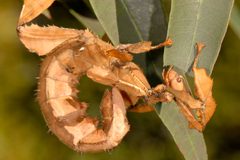
2is a of stick insects characterized by extreme elongation of the body and limbs to resemble twigs or branches. Members range from small to the largest insects known, with Phobaeticus chani reaching 567 mm total length. The family exhibits remarkable through body form, coloration, and , including swaying movements that mimic branches in wind. Many species possess defensive chemical glands when camouflage fails. The family has undergone significant taxonomic revision, with six recognized in Phasmatidae sensu stricto.
Pronunciation
How to pronounce Phasmatidae: /fæzˈmætɪˌdeɪ/
These audio files are automatically generated. While they are not always 100% accurate, they are a good starting point.
Identification
are distinguished from other by a combination of exoskeletal features, , and male genital structures. Key diagnostic characters include: with euplantulae (adhesive pads) on mid- and hindlegs; vomer (male clasping structure) configuration; egg micropylar plate structure (open or closed); and presence or absence of capitulum on eggs. The family contains some of the most elongate insects, with body lengths exceeding 350 mm in some . are typically long and . Wings are reduced or absent in many species; when present, tegmina are often shortened and alae may be present in males of some .
Images
Habitat
Tropical and temperate forests, woodlands, and shrublands where vegetation provides structural support and food resources. occupy diverse arboreal and shrub-layer from rainforest to temperate deciduous forests. Many species show specific associations with particular plants for feeding and oviposition.
Distribution
in tropical and subtropical regions with extensions into temperate zones. Major centers of diversity include Southeast Asia (Borneo, Vietnam, Thailand), Australasia (Australia, New Zealand), Madagascar, and the Neotropics. The is notably absent from the Nearctic region except for introduced and limited native occurrences. Distribution varies by : primarily Oriental and Australasian; Tropidoderinae Australasian; Extatosomatinae restricted to Australasia; Cladomorphinae Neotropical and Madagascar; Lonchodinae Oriental and Australasian; Pachymorphinae Asian and Australasian.
Diet
Exclusive folivores (leaf-feeders). Diet consists entirely of plant foliage, with many showing specificity to particular plants. Laboratory rearing studies indicate acceptance of diverse plant materials including guava (Psidium guajava), oak, and various shrubs and trees.
Life Cycle
Hemimetabolous development with , nymph, and stages. Eggs are typically large and structurally complex, often with external appendages (capitula) that facilitate by ants. Some deposit eggs on plants; others drop eggs to the ground. typically occurs in the egg stage in temperate species. Nymphs resemble adults in general form but lack fully developed genitalia. Development is gradual with multiple ; adults may live for extended periods. studies indicate type II with relatively constant mortality throughout life.
Behavior
Masters of (camouflage) using multiple strategies: morphological resemblance to twigs or leaves; color matching to substrate; and behavioral mimicry including slow swaying movements that simulate branches moving in breeze. When stationary, many assume a twig-like posture with forelegs extended forward, remaining motionless for hours. Some species exhibit (death-feigning). When threatened, several species discharge defensive secretions from prothoracic or metasternal glands; these chemicals are typically foul-smelling and irritating to . Some species are capable of (voluntary leg loss) and subsequent of limbs. has been documented in some .
Ecological Role
Herbivores that consume leaf , occasionally reaching densities sufficient to cause localized defoliation. with capitula form mutualistic relationships with ants (myrmecochory), gaining and burial services. Serve as prey for diverse including birds, reptiles, and arthropods; their chemical defenses and represent significant on predator foraging strategies. Contribute to nutrient cycling through herbivory and as prey items.
Human Relevance
Popular in entomological education and live insect collections due to their remarkable appearance and harmless nature. Some are kept as pets or display animals in museum
Similar Taxa
- DiapheromeridaeHistorically confused with ; distinguished by different tarsal structure (lacking euplantulae on mid- and hindlegs) and . Lonchodinae was transferred from Diapheromeridae to Phasmatidae based on genital and egg features.
- HeteropterygidaeAnother of stick insects with more robust body form and different defensive strategies; lacks the extreme elongation characteristic of many .
- PseudophasmatidaeNew World with convergent twig-like appearance but distinct genital and structure.
More Details
Taxonomic instability
The has undergone extensive revision. Bradley & Galil (1977) recognized sensu lato including many now transferred elsewhere. Zompro (2004) and subsequent established Phasmatidae sensu stricto with six subfamilies (, Tropidoderinae, Extatosomatinae, , Pachymorphinae, Platycraninae) and transferred Lonchodinae and Clitumninae to Phasmatidae sensu lato. The subfamily Phasmatinae was shown to be polyphyletic, with Pharnaciini and Clitumnini removed to new subfamily Clitumninae.
Record size
Phobaeticus chani from Borneo holds the record for longest insect at 567 mm total length (357 mm body length). Phryganistria heusii yentuensis represents the second longest insect known. These giant inhabit rainforest where their extreme elongation enhances among long twigs and branches.
Ant mutualism
Many bear capitulum structures that attract ants. of Pristomyrmex punctatus and other ants disperse eggs, remove capitula for food, and sometimes bury eggs at shallow depths. This myrmecochory provides away from parent plants and potential protection from and environmental hazards, though hatchlings must escape nests to reach plants.
Sources and further reading
- BugGuide
- Wikipedia
- GBIF taxonomy match
- iNaturalist taxon
- NCBI Taxonomy
- Catalogue of Life
- Assistant Professor Matan Shelomi: He'll Introduce You to His Stick Insect Research | Bug Squad
- Know Your Sticks | Bug Squad
- Twiggy - Walking sticks, Phasmatidae — Bug of the Week
- Destinations La Torre, Peru, and Carara, Costa Rica – Hidin’ in the Rainforest, Part II: cryptic walking sticks, Phasmatidae; horse-head grasshoppers, Proscopidiidae; and mantids, Mantidae — Bug of the Week
- From the Bug of the Week mailbag: World’s largest walking stick visits the Goddard Space Flight Center, Northern walkingstick, Diapheromera fermorata — Bug of the Week
- Archive — Bug of the Week
- Distribution of Diapheromera femorata(Orthoptera: Phasmatidae)1
- Distribution of Diapheromera femorata (Orthoptera: Phasmatidae)1
- Revision of Oriental Phasmatodea: The tribe PharnaciiniGünther, 1953, including the description of the world's longestinsect, and a survey of the family Phasmatidae Gray, 1835 withkeys to the subfamilies and tribes(Phasmatodea: "Anareolatae": Phasmatidae)
- Predation strategies of Harpactor angulosus (Lepeletier & Serville, 1825) (Hemiptera: Reduviidae) on Cladomorphus phyllinus Gray, 1835 (Phasmatodea: Phasmatidae) in captivity
- Behavioral Observations of the Walking Stick, Anisomorpha buprestoides (Phasmatodea: Phasmatidae)
- The new genus of stick insect Lobofemora from Vietnam, with the description of three new species (Phasmida: Phasmatidae: Clitumnini)
- A SECOND GENUS AND SPECIES OF TERUELPHASMINI YONG, 2017 (PHASMIDA: PHASMATIDAE: CLADOMORPHINAE), FROM THE HIGH MOUNTAINS OF CENTRAL CUBA
- Giant Sticks from Vietnam and China, with three new taxa including the second longest insect known to date (Phasmatodea, Phasmatidae, Clitumninae, Pharnaciini)
- Dispersal of Phraortes illepidus (Phasmida: Phasmatidae) Eggs by Workers of the Queenless Ant, Pristomyrmex punctatus (Hymenoptera: Formicidae)
- Population parameters and dynamic life table of stick-insect Cladomorphus phyllinus Gray, 1835 (Phasmatidae, Cladomorphinae)
- Structural and Taxonomic Components of Habitat Selection in the Neotropical Folivore Lamponius portoricensis (Phasmatodea: Phasmatidae)