
Parabacillus hesperus
Hebard, 1934
western short-horn walkingstick, western short-horned walkingstick
Parabacillus hesperus is a in the Heteronemiidae, commonly known as the western short-horn walkingstick. It exhibits strong , blending with vegetation to avoid detection by . The species has been documented across the western United States with recent range extensions into the Pacific Northwest.

Pronunciation
How to pronounce Parabacillus hesperus: //ˌpærəˈbæsɪləs ˈhɛspərəs//
These audio files are automatically generated. While they are not always 100% accurate, they are a good starting point.
Identification
Distinguished from other walkingsticks by its relatively short (the "short-horn" characteristic) and association with dry, arid . May be confused with other Parabacillus or members of Heteronemiidae; precise identification may require examination of genitalia or other structural features not detailed in general sources.
Images
Appearance
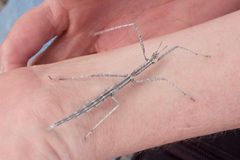
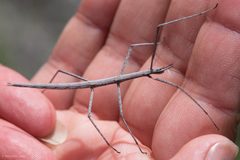
Slender, elongated body resembling twigs or stems. Short relative to body length, characteristic of the "short-horn" . Body form adapted for camouflage among grasses and scrub vegetation. Coloration typically matches local plant material, though specific color patterns are not well documented in available sources.
Habitat
Dry, arid regions including scrublands and grasslands. Associated with open, sun-exposed with grasses and low vegetation.
Distribution
Western United States. Documented in Arizona, California, Nevada, New Mexico, and Oregon. Recently recorded in Washington and Idaho, representing northward range extension in the Pacific Northwest.
Diet
Various scrub and grassland plants. Specific plant are not documented.
Behavior
Exhibits —remaining motionless and blending with vegetation to avoid detection by . Activity patterns and specific are not well documented.
Ecological Role
Herbivore in arid grassland and scrub . Serves as prey for visually hunting , though its cryptic reduces detection risk.
Human Relevance
Occasionally encountered by naturalists and entomologists in western North America. Not known to be of economic importance.
Similar Taxa
- Other Parabacillus speciesSimilar body form and preferences; may require detailed examination for separation
- Other HeteronemiidaeShared characteristics of short and twig-like appearance
More Details
Taxonomic history
First described by Hebard in 1934. The epithet "hesperus" refers to the western (evening/west) distribution of this species.
Range expansion
Documentation of new state records for Washington and Idaho in 2017 indicates ongoing northward expansion or previously undocumented in the Pacific Northwest.
Sources and further reading
- BugGuide
- Wikipedia
- GBIF taxonomy match
- iNaturalist taxon
- Catalogue of Life
- There's a Black Widow Spider in the Parade! | Bug Squad
- And Then There Were Three: New Termite Species Identified in California
- Researchers Share New Method for Detecting Insect Egg Predators
- Western U.S. Has More Subterranean Termite Species Than Previously Thought, Study Shows
- From Burglars to Bugs: Anti-Theft Dye Useful in Insect-Tracking Studies
- Bug Eric: National Moth Week Recap for Colorado Springs
- Parabacillus hesperus Hebard, 1934 (Phasmida: Heteronemiidae): new state records for Washington and Idaho and an assessment of its distribution in the Pacific Northwest (U.S.A.)