
Scudderia curvicauda
(De Geer, 1773)
Curve-tailed Bush Katydid
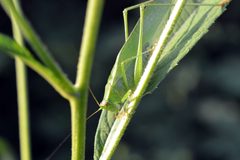
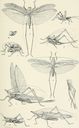
Scudderia curvicauda, commonly known as the curve-tailed bush , is a of katydid in the Tettigoniidae. It is found in North America, with records from states including Alabama, Arkansas, Florida, Georgia, Illinois, and other regions. The species was first described by De Geer in 1773. Like other Scudderia species, it is a bush-dwelling katydid with cryptic coloration.
Pronunciation
How to pronounce Scudderia curvicauda: /skʌˈdɛɹiə kɜːˈvɪkaʊdə/
These audio files are automatically generated. While they are not always 100% accurate, they are a good starting point.
Identification
The Scudderia contains eight recognized in the United States and southern Canada, most of which are extremely difficult to distinguish without examining male specimens. The only reliable method for species-level identification in Scudderia is examination of the male supra-anal plate ( process), a horn-like structure at the rear of the . In S. curvicauda, this structure is curved, corresponding to the species epithet. The sub-genital plate curves up from below to meet this structure. Living specimens in the field are generally unidentifiable to species because folded wings conceal these diagnostic features. Most specimens are green, though late-season individuals may show brownish, reddish, or pinkish coloration.
Images
Distribution
North America. Documented distribution records include Alabama, Arkansas, Florida, Georgia, and Illinois. The occurs in association with vegetation in its native range.
Similar Taxa
- Scudderia furcataFork-tailed bush is the most widespread and transcontinental Scudderia , overlapping in range with S. curvicauda. Distinguished by fork-shaped (rather than curved) supra-anal plate in males. The two species are otherwise nearly identical in appearance and preferences.
- Other Scudderia speciesSix additional Scudderia occur in North America, all requiring examination of male genitalic structures for definitive identification. Most have restricted geographic ranges compared to S. curvicauda and S. furcata.
More Details
Taxonomic Note
Scudderia curvicauda was originally described as Locusta curvicauda by De Geer in 1773. The is classified in the tribe Scudderiini within the Phaneropterinae.
Identification Challenges
The Scudderia presents significant identification challenges. Field observations of living specimens cannot reliably distinguish due to concealing wing folds. Accurate identification requires collection and dissection of males to examine the shape of the supra-anal plate. This has likely led to underreporting and misidentification in many records.
Sources and further reading
- BugGuide
- Wikipedia
- GBIF taxonomy match
- iNaturalist taxon
- NCBI Taxonomy
- Catalogue of Life
- Bodil Cass and 'The Curious Case of Katydids in California Citrus' | Bug Squad
- Archive — Bug of the Week
- Bug Eric: Fork-tailed Bush Katydid
- Mandarin Boom Means Citrus Pest Management Must Evolve
- 🪲 Entomologizing w/ the WGNSS Entomology Group at Hughes Mountain Natural Area — 11 Oct 2025 | Beetles In The Bush
- Bug Eric: Wasp Wednesday: Great Golden Digger