
Arethaea phalangium
(Scudder, 1877)
Eastern Thread-leg Katydid
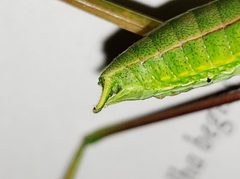
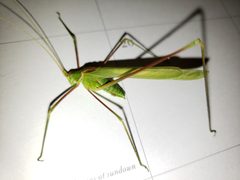
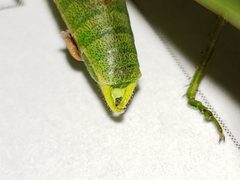
Arethaea phalangium is a in the Tettigoniidae, commonly known as the eastern thread-leg katydid. It belongs to the Arethaea, which is characterized by species with extremely slender, thread-like legs—an referenced in both the genus name and the specific epithet 'phalangium' (meaning 'spider-like'). The species is found in the southeastern United States.
Pronunciation
How to pronounce Arethaea phalangium: /æ.ɹəˈθiː.ə fəˈlæn.dʒi.əm/
These audio files are automatically generated. While they are not always 100% accurate, they are a good starting point.
Identification
Members of the Arethaea are distinguished from other katydids by their exceptionally long, slender legs that appear thread-like. The specific epithet 'phalangium' (Latin for spider) alludes to this spider-like leg . Within the genus, A. phalangium can be separated from western such as A. mescalero by geographic distribution—A. phalangium occurs in the southeastern United States while A. mescalero is found in the southwestern United States and northern Mexico.
Images
Distribution
Southeastern United States: Alabama, Florida, Georgia, and South Carolina.
Similar Taxa
- Arethaea mescaleroAlso has thread-like legs and similar body plan, but occurs in southwestern United States and northern Mexico rather than the Southeast; can be distinguished by geographic range.
- Other Phaneropterinae katydidsLack the extremely elongated, thread-like leg characteristic of Arethaea.
More Details
Etymology
The specific epithet 'phalangium' derives from Latin, meaning 'spider' or 'spider-like,' referring to the ' long, thin legs that resemble spider legs. The name Arethaea similarly evokes slenderness.
Taxonomic History
Originally described by Samuel Hubbard Scudder in 1877. The has remained in the Arethaea since description, with the genus currently placed in the tribe Insarini within Phaneropterinae.