
Bucrates malivolans
(Scudder, 1878)
Cattail Conehead
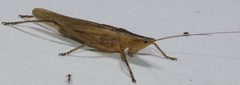
Bucrates malivolans, commonly known as the Cattail Conehead, is a in the Tettigoniidae. It occurs in the southeastern United States, with records from Alabama, Arkansas, Florida, Georgia, and Louisiana. The species is associated with wetland , particularly those supporting cattail vegetation. It belongs to the conehead tribe Copiphorini, characterized by elongated cone-shaped .
Pronunciation
How to pronounce Bucrates malivolans: /buːˈkreɪtiːz ˌmælɪvoʊˈlæns/
These audio files are automatically generated. While they are not always 100% accurate, they are a good starting point.
Identification
Distinguished from other coneheads by combination of geographic range and association with cattail wetlands. Separation from congeneric requires examination of male genitalia and detailed morphological characters; B. capreolus is the only other species in the and occurs in different regions. The 'Cattail Conehead' reflects its association, which aids field recognition.
Images
Appearance
Possesses the elongated, cone-shaped typical of Copiphorini coneheads. As a member of Bucrates, likely exhibits a slender body form with long characteristic of Tettigoniidae. Specific coloration and body proportions require direct specimen examination.
Habitat
Wetland environments, particularly marshes and edges of water bodies supporting Typha (cattail) vegetation. The and iNaturalist observations indicate strong association with cattail stands.
Distribution
Southeastern United States: Alabama, Arkansas, Florida, Georgia, and Louisiana.
Similar Taxa
- Bucrates capreolusOnly other in Bucrates; distinguished by geographic distribution and morphological details of male genitalia
- Other Copiphorini coneheads (e.g., Neoconocephalus, Belocephalus)Share cone-shaped but differ in body proportions, stridulatory features, and preferences; precise identification requires examination of head shape and wing venation
More Details
Taxonomic history
Originally described as Conocephalus malivolans by Scudder in 1878, later transferred to Bucrates. The genus Bucrates currently contains only two .
Observation frequency
Documented in 235 iNaturalist observations, indicating moderate levels of detection by naturalists, likely due to its association with conspicuous cattail stands.