
Oecanthus beameri
Collins & Lightfoot, 2022
White Sands Tree Cricket
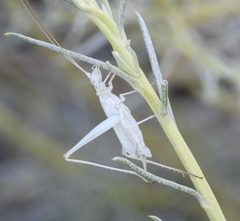
Oecanthus beameri is a recently described of tree discovered by citizen scientist Nancy Collins and formally named in 2022. It is one of the smallest members of the Oecanthus. The species is known from very few observations, with iNaturalist records indicating only two documented sightings. As a newly described , much of its remains undocumented.
Pronunciation
How to pronounce Oecanthus beameri: /iːˈkænθəs ˈbiːmɛraɪ/
These audio files are automatically generated. While they are not always 100% accurate, they are a good starting point.
Identification
Identification of Oecanthus beameri relies on markings on the first two antennal segments at the base of the , as is typical for the . Males have greatly expanded, paddle-shaped forewings modified for sound production, while females possess a short, stout ovipositor visible at the tip. The is distinguished from by specific antennal markings, though precise diagnostic characters require examination.
Images
Distribution
Known from White Sands, New Mexico, based on type locality and limited observation records.
Similar Taxa
- Oecanthus argentinusPrairie tree cricket with overlapping geographic range in southwestern United States; distinguished by antennal markings.
- Oecanthus californicusWestern tree cricket found in arid and semi-arid regions; requires examination of antennal segments for separation.
- Oecanthus quadripunctatusFour-spotted tree cricket with which it shares the characteristic of distinctive antennal markings; specific pattern differs.
More Details
Taxonomic History
The was formally described in 2022 by Nancy Collins and David Lightfoot, making it one of the most recently named tree species in North America. Collins, a citizen scientist, had built expertise in Oecanthus identification through years of study and photography, leading to the discovery of this previously unrecognized species.
Conservation Status
With only two known observations in iNaturalist as of the data cutoff, O. beameri may be genuinely rare, locally to the White Sands region, or underdetected due to its recent description and the difficulty of identifying Oecanthus in the field.