
Oecanthus californicus
Saussure, 1874
Western Tree Cricket
Species Guides
1Oecanthus californicus, the Western Tree , is a of tree cricket in the Oecanthidae. It is found in western North America, including the southwestern United States and Mexico. The species is one of five tree cricket species recorded in Colorado. Males produce songs by stridulating their forewings to attract females, and engage in courtship feeding involving a metanotal gland secretion. The species has been observed in ranging from coniferous woodlands to grassy fields and meadows.
Pronunciation
How to pronounce Oecanthus californicus: /iːˈkænθəs ˌkælɪˈfɔːrnɪkəs/
These audio files are automatically generated. While they are not always 100% accurate, they are a good starting point.
Identification
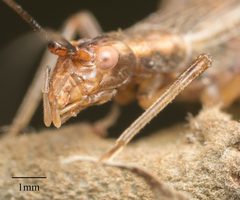
Identification to level within the Oecanthus is difficult and typically requires examination of markings on the first two antennal segments at the base of the . The Western Tree can be distinguished from other Colorado species by these antennal markings. Males have greatly expanded, paddle-shaped forewings used for sound production, while females have slender forewings that hug the body tightly and possess a short, stout ovipositor visible at the tip.
Images
Habitat
Found in diverse including coniferous woodlands, grassy fields, meadows, and areas with tall weeds. In southwestern Utah, has been observed on trunks of Pinus edulis (Colorado pinyon pine) at night. Also occurs in areas with yucca and rabbitbrush.
Distribution
North America. Recorded from Mexico, Arizona, California, Colorado, Idaho, Utah, Nevada, New Mexico, and Oklahoma. One of five Oecanthus present in Colorado.
Seasonality
have been observed in late summer and early fall, with records from June through September. Peak activity appears to occur in late summer.
Diet
, feeding on plants and small insects such as aphids.
Behavior
Males sing by raising forewings into a shape at a 90-degree angle to the body, producing sound by drawing a scraper on one wing across a file on the other. Some males align wings with gaps in foliage or chew holes in leaves to reduce acoustic interference. Upon attracting a female, males switch to a softer song and expose a metanotal gland on the ; the female feeds on its secretion while the male transfers a . Females use their ovipositor to insert into berry canes and other plant stems.
Ecological Role
of small soft-bodied insects such as aphids; also functions as herbivore. Serves as prey for various . Male songs contribute to acoustic environment of .
Human Relevance
Subject of citizen science and natural history observation. Audio recordings of male songs have been contributed to platforms such as iNaturalist.
Similar Taxa
- Oecanthus argentinusPrairie Tree Cricket, also found in Colorado; distinguished by antennal markings
- Oecanthus fultoniSnowy Tree Cricket, also found in Colorado; distinguished by antennal markings
- Oecanthus nigricornisBlack-horned Tree Cricket, also found in Colorado; distinguished by antennal markings
- Oecanthus quadripunctatusFour-spotted Tree Cricket, also found in Colorado; distinguished by antennal markings
Sources and further reading
- BugGuide
- Wikipedia
- GBIF taxonomy match
- iNaturalist taxon
- Catalogue of Life
- Grasshoppers of Colorado
- Grasshoppers of Colorado
- Oecanthidae | Beetles In The Bush
- tree crickets | Beetles In The Bush
- Bug Eric: Tree Cricket Courtship
- The Changing Distributions of our Grasshoppers, Crickets and Relatives - Buglife Blog - Buglife