
Eunemobius melodius
(Thomas & Alexander, 1957)
Melodious Ground Cricket
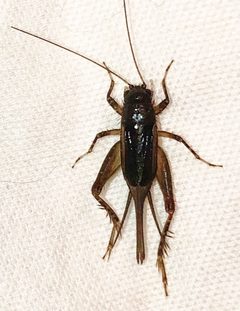
Eunemobius melodius is a small ground cricket native to eastern North America. It produces a distinctive, melodious trill that distinguishes it acoustically from . The inhabits moist ground-level vegetation and leaf litter in forested and semi-open . It is one of several Eunemobius species whose identification relies heavily on male calling song characteristics.
Pronunciation
How to pronounce Eunemobius melodius: /juːˈnɛmoʊbiəs mɛˈloʊdiəs/
These audio files are automatically generated. While they are not always 100% accurate, they are a good starting point.
Identification
Identification of Eunemobius melodius relies primarily on male calling song: a continuous, melodious trill delivered at a moderate pulse rate, distinct from the faster, more erratic songs of related such as Eunemobius carolinus and E. confusus. Visual identification to species level within Eunemobius is unreliable without acoustic confirmation due to minimal morphological differentiation among .
Images
Habitat
Moist ground-level vegetation, leaf litter, and low herbaceous growth in deciduous forests, woodland edges, and semi-open areas with shaded conditions.
Distribution
Eastern United States: recorded from Florida, Georgia, Indiana, Louisiana, and Michigan.
Behavior
Males produce a continuous trilling call from concealed positions in ground vegetation, typically at night.
Similar Taxa
- Eunemobius carolinusOverlapping range and ; distinguished by faster, more irregular calling song with distinct pulse pattern.
- Eunemobius confususSympatric in parts of range; song is faster and less melodious, with shorter trill duration.
- Eunemobius melodiusOther Eunemobius require acoustic analysis for reliable separation; morphological characters are insufficient.
More Details
Acoustic identification importance
The Eunemobius exhibits minimal external morphological variation, making male calling song the primary diagnostic character for -level identification. Spectrogram analysis of pulse rate and trill continuity is standard practice.