
Gryllus ovisopis
Walker, 1974
Taciturn Wood Cricket
Gryllus ovisopis, commonly known as the taciturn wood , is a field cricket notable for its lack of a calling song—a rare trait among crickets. Described by Walker in 1974, this species exhibits darker forewings and non-functional hindwings. Its involves as that hatch in April, with synchronous maturation occurring in September. The species inhabits moist woodlands in the southeastern United States and shares its geographic range with Gryllus fultoni.
Pronunciation
How to pronounce Gryllus ovisopis: //ˈɡrɪl.jʊs ˌoʊ.vɪˈsoʊ.pɪs//
These audio files are automatically generated. While they are not always 100% accurate, they are a good starting point.
Identification
Distinguished from sympatric Gryllus fultoni and other field crickets by darker forewings and non-functional hindwings. Most reliably identified by the absence of a calling song—males produce only fight and courtship songs using specialized forewing structures (file and scraper), unlike typical calling crickets.
Images
Appearance
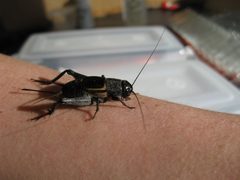
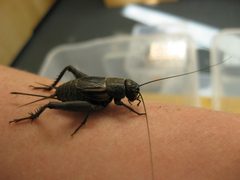
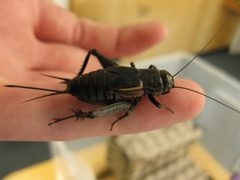
Darker forewings compared to related ; non-functional hindwings present.
Habitat
Moist broadleaf woodlands and loblolly pine forests in the southeastern coastal plain.
Distribution
Southeastern United States: Florida, Georgia, and South Carolina. Range overlaps with Gryllus fultoni.
Seasonality
hatch in April; mature synchronously in September. Active primarily during late summer and early autumn.
Life Cycle
Overwinters as deposited in soil. Nymphs emerge in April and develop through spring and summer. reach maturity synchronously in September. Specific details regarding number of instars or nymphal development duration not documented.
Behavior
Males lack a calling song, an unusual trait among crickets. Instead, males produce fight songs and courtship songs using forewing stridulatory structures. This reduced acoustic signaling suggests reliance on alternative mate-location strategies compared to typical field crickets.
Similar Taxa
- Gryllus fultoniOverlapping range in southeastern United States; distinguished by G. ovisopis having darker forewings, non-functional hindwings, and absence of calling song
- Gryllus pennsylvanicusSimilar body plan and membership; distinguished by G. ovisopis lacking calling song and having darker forewings with non-functional hindwings
More Details
Allochronic Speciation
The ' pattern, with synchronous September maturation and spring hatch, has been suggested as evidence for —temporal isolation in breeding periods potentially driving divergence from related species.
Acoustic Communication
Despite lacking a calling song, males retain functional stridulatory apparatus and produce context-specific songs (fight and courtship), indicating evolutionary modification rather than complete loss of acoustic signaling.
Sources and further reading
- BugGuide
- Wikipedia
- GBIF taxonomy match
- iNaturalist taxon
- NCBI Taxonomy
- Catalogue of Life
- Host and a Parasite: Battle of Sand Field Crickets vs. Horsehair Worms | Bug Squad
- Grasshoppers of Colorado
- Home invaders III - Fall field cricket, Gryllus pennsylvanicus — Bug of the Week
- The troubadour downstairs – fall field cricket, Gryllus pennsylvanicus — Bug of the Week
- What’s all this chirping about? Ask the fall field cricket, Gryllus pennsylvanicus — Bug of the Week
- Field crickets invade a home with a wake-up call: Fall field cricket, Gryllus pennsylvanicus — Bug of the Week
- Taciturn Wood Cricket, Gryllus ovisopis (T. Walker) (Insecta: Orthoptera: Gryllidae)
- Gryllus ovisopis N. Sp.: A Taciturn Cricket with a Life Cycle Suggesting Allochronic Speciation