
Gryllus firmus
Scudder, 1902
Sand Field Cricket, Sand Cricket
Gryllus firmus, the sand field cricket, is a wing-polymorphic native to the southeastern United States. It exhibits a distinctive chirping call that distinguishes it from the trilling calls of closely related . The species is notable for producing two types—fast-developing and eggs—within single clutches, an to unpredictable conditions in sandy . Wing morphs are associated with trade-offs between and : long-winged individuals can fly but have reduced , while short-winged individuals have enhanced reproductive output. The species hybridizes with Gryllus pennsylvanicus where their ranges overlap.
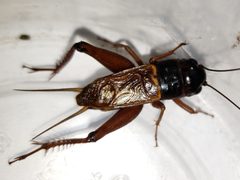
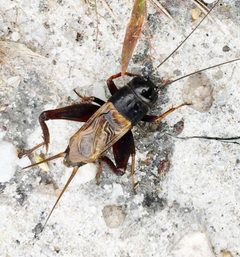
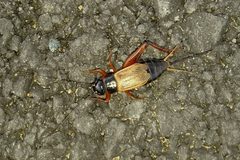
Pronunciation
How to pronounce Gryllus firmus: /ˈɡrɪl.lʊs ˈfɪr.mʊs/
These audio files are automatically generated. While they are not always 100% accurate, they are a good starting point.
Identification
Distinguished from Gryllus rubens and Gryllus texensis by chirping song (the other two trill), and by forewing coloration and venation patterns. Males produce chirps by rubbing the scraper of one forewing against the file of the other; this differs from the continuous trill of related species. Visual identification of wing venation requires close examination.
Images
Habitat
Grassland, pasture, roadside verges, and lawns on light, free-draining sandy soils. Ephemeral such as sand dunes. Sandy, fast-drying soils with variable temperature and moisture content.
Distribution
Coastal plain of the southeastern United States, from Connecticut and New Hampshire south to Florida and Texas. Replaced by Gryllus pennsylvanicus to the north and west; limited hybridization occurs in zone of overlap.
Host Associations
- Paragordius varius - ; lives inside for 28+ days, growing up to 30 cm; reduces host growth, survival, and
- eugregarine parasites - Gut-dwelling protozoans; intensity of positively correlated with body size
Life Cycle
. Nymphs emerge from in spring. present in summer and autumn. Wing present: long-winged morph is migratory; short-winged morph has enhanced . Oviposition produces mixed clutches containing two egg types: fast-developing eggs hatch in 2–4 weeks, and eggs with delayed hatching after 5–28 weeks. Individual females produce both types, with fast-developing eggs comprising 50–95% of clutch.
Behavior
Males chirp to attract females and defend territories; females select mates based on song quality. Chirp rate varies with temperature, permitting rough temperature estimation. Males engage in aggressive interactions involving grappling and jaw-snapping. capability in long-winged morph enables ; short-winged morph prioritizes . Flight muscle histolysis in some long-winged shifts resources to reproduction.
Ecological Role
Primary consumer; contributes to nutrient cycling through feeding and decomposition. Serves as for parasitic and gut protozoans. Wing represents a strategy for persistence in unpredictable environments. Hybridization with Gryllus pennsylvanicus contributes to studies of speciation dynamics.
Human Relevance
Occasional household invader in autumn, entering through gaps around doors, windows, and foundations. Chirping can be audible indoors. Subject of extensive research on wing , life-history trade-offs, and speciation. Used in studies of immune function, , and reproductive .
Similar Taxa
- Gryllus rubensSoutheastern field cricket; distinguished by trilling song rather than chirping, and different forewing venation
- Gryllus texensisTexas field cricket; distinguished by trilling song rather than chirping
- Gryllus pennsylvanicusFall field cricket; replaces G. firmus to the north and west; produces trilling song; hybridizes with G. firmus where ranges overlap
Sources and further reading
- BugGuide
- Wikipedia
- GBIF taxonomy match
- iNaturalist taxon
- NCBI Taxonomy
- Catalogue of Life
- Host and a Parasite: Battle of Sand Field Crickets vs. Horsehair Worms | Bug Squad
- Grasshoppers of Colorado
- The Entomologist Who Almost Wasn't: A Tale on the Importance of Inclusive K-12 Education
- Home invaders III - Fall field cricket, Gryllus pennsylvanicus — Bug of the Week
- The troubadour downstairs – fall field cricket, Gryllus pennsylvanicus — Bug of the Week
- What’s all this chirping about? Ask the fall field cricket, Gryllus pennsylvanicus — Bug of the Week
- Sand Field Cricket, Gryllus firmus Scudder (Insecta: Orthoptera: Gryllidae)
- Effects of inbreeding on morphological and life history traits of the sand cricket, Gryllus firmus
- Immunity, Sex and Parasites: Does Sex of Sand-Field Cricket (Gryllus firmus) Affect Immune Response to Eugregarine Parasites?
- Genes with Restricted Introgression in a Field Cricket (Gryllus firmus/Gryllus pennsylvanicus) Hybrid Zone Are Concentrated on the X Chromosome and a Single Autosome
- Effects of inbreeding on morphological and life history traits of the sand cricket, Gryllus firmus
- Influence of female cuticular hydrocarbon (CHC) profile on male courtship behavior in two hybridizing field crickets Gryllus firmus and Gryllus pennsylvanicus
- Extra-nuclear effects on growth and development in the sand cricket Gryllus firmus
- Fitness differences associated with calling behaviour in the two wing morphs of male sand crickets, Gryllus firmus