
Tropidolophus formosus
(Say, 1825)
Great Crested Grasshopper
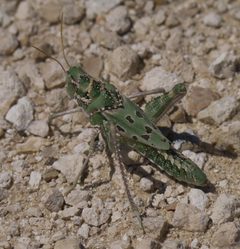
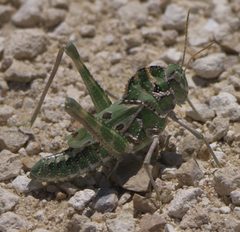
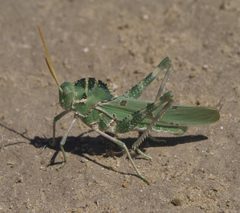
Tropidolophus formosus, the Great Crested Grasshopper, is the sole in the Tropidolophus. This band-winged grasshopper is native to North America and has been reported in southeastern Wyoming and Colorado. The species is distinguished by a prominent crest on the pronotum, which gives rise to both its scientific and . It belongs to the Oedipodinae, a group characterized by enlarged hind wings often with dark bands.
Pronunciation
How to pronounce Tropidolophus formosus: /ˌtrɒpɪˈdɒləfəs fɔːrˈmoʊsəs/
These audio files are automatically generated. While they are not always 100% accurate, they are a good starting point.
Identification
The elevated pronotal crest extending posteriorly over the is diagnostic for this and distinguishes it from all other North . The Tropidolophus has no close relatives in the region, making identification straightforward once the crest is observed. The banded hind wings place it in Oedipodinae, but the crest structure separates it from other band-winged genera such as Trimerotropis and Arphia.
Images
Appearance
Medium to large with a distinctive elevated crest on the pronotum that extends backward over the . The pronotal crest is the most conspicuous feature, giving the its . Body coloration is typically cryptic, blending with soil and vegetation. Hind wings, when exposed in , display the dark banding pattern characteristic of Oedipodinae. are relatively short and .
Habitat
Specific preferences are not well documented in the available sources. Based on its recorded distribution in southeastern Wyoming and Colorado, it likely occupies grassland and rangeland habitats in the western Great Plains and foothill regions.
Distribution
Recorded from southeastern Wyoming and Colorado. GBIF distribution records also indicate presence in northeastern Mexico. The was not collected during the 1988-2018 Wyoming systematic survey, indicating it may be rare, localized, or seasonally mismatched with standard survey timing.
Seasonality
activity period is not precisely documented. Given that it was not captured in Wyoming surveys conducted primarily from July 10 to August 20, it may be active earlier in the season or have that does not overlap with peak survey periods.
Human Relevance
Not listed among economically important pest in Wyoming or Colorado. The species appears to have no significant agricultural impact and is not targeted in management programs.
Similar Taxa
- Trimerotropis spp.Other band-winged grasshoppers with dark-banded hind wings, but lack the prominent pronotal crest; pronotum is typically flattened or saddle-shaped rather than crested
- Arphia spp.Band-winged grasshoppers with similar hind wing coloration, but have uncrested pronota and different body proportions
- Spharagemon spp.Grasshoppers with somewhat elevated pronota, but crest is not as pronounced or extended as in Tropidolophus
More Details
Taxonomic uniqueness
Tropidolophus is , with T. formosus as its sole . The is placed in the tribe Tropidolophini, which reflects its isolated phylogenetic position within Oedipodinae.
Survey underrepresentation
The was specifically noted as having been previously recorded in Wyoming but not collected during the extensive 1988-2018 survey. This may reflect true rarity, highly localized distribution, or phenological mismatch with survey timing focused on economically important species.