
Trimerotropis pallidipennis
(Burmeister)
Pallid-winged Grasshopper, Pallidwinged Grasshopper
Trimerotropis pallidipennis is a moderately-sized bandwinged with the widest distribution of any bandwinged grasshopper in the New World, ranging from southwestern Canada to Argentina. It is primarily a desert and semi-desert that exhibits sporadic irruptive in western North America, during which it becomes a significant agricultural pest. The species possesses strong capabilities that enable long-distance and from deteriorating . Population irruptions have been documented in Arizona, California, New Mexico, and Utah, with outbreaks typically lasting one to two years.
Pronunciation
How to pronounce Trimerotropis pallidipennis: /ˌtraɪməˈrɒtrəpɪs pælɪdɪˈpɛnɪs/
These audio files are automatically generated. While they are not always 100% accurate, they are a good starting point.
Identification
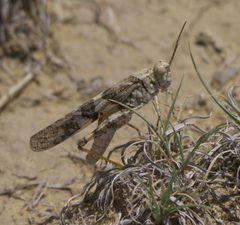
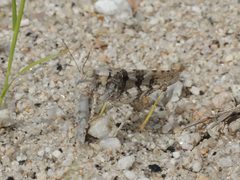
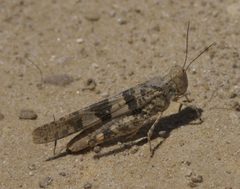
Distinguished from other Trimerotropis by the combination of: narrow black band on hindwing (broader in many ), two complete transverse dark bands on tegmen, black inner medial area of hind with two yellow bars, straight edge of pronotal lobe without tooth, and yellow hind tibia. Nymphs are identifiable by triangular foveolae on the , twice-incised carina on pronotum, and characteristic color patterns: instar I has mainly black hindleg with pale basal fourth of femur; instars III-V have pale tan hind femur with two or three black bars and yellow hind tibia.
Images
Appearance
are moderately-sized, tan to gray grasshoppers with distinct wing patterns. The tegmen (forewing) bears two transverse dark bands crossing its entire width, with numerous brown spots at the end. The hindwing has a relatively narrow but conspicuous black band across the center, with a white to pale yellow wing disk and transparent area. The pronotum has a carina incised twice near the front—high on the prozona and low but distinct on the metazona—with a straight edge bearing no tooth. The inner medial area of the hind is black, broken by two yellow bars. The hind tibia is yellow. The venter is solid cream to pale yellow. Live weight varies with environmental conditions: males average 175-268 mg, females 399-565 mg.
Habitat
Primary are desert and semi-desert rangelands of western North America, characterized by shrubs, forbs, and grasses with abundant bare ground for basking and resting. Vegetation includes grasses such as downy brome and needle grama, grasses, and various forbs. Outside natural rangelands, establish in weedy city lots and disturbed areas. Habitats with succulent vegetation support faster reproductive maturation than dry desert sites.
Distribution
Ranges from southwestern Canada (southern Alberta, Saskatchewan) through the western United States to Mexico, Central America, and South America to Argentina. In the United States, occurs in Washington, Oregon, California, Nevada, Arizona, Utah, Idaho, Montana, Wyoming, Colorado, New Mexico, and Texas. The most widely distributed bandwinged in the New World. Introduced to Hawaii (Oahu) in 1966, where it persisted through 1968.
Seasonality
Hatching begins in late February to March in southern Arizona, late April in Utah, and May to June in Colorado and Wyoming. Nymphal development lasts 31-60 days depending on temperature. appear mid-April in southern Arizona and early June in northern states. In southern Arizona, a second hatches in early June; northern areas have only one generation. Adults present from spring through summer, with some individuals surviving 67+ days in favorable .
Diet
, feeding on a variety of forbs and grasses with diet shifting based on availability and quality. Early spring nymphs feed on lush grasses (downy brome, needle grama). As annual grasses dry, grasshoppers switch to green grasses and forbs. Crop contents have revealed: downy brome (63% of crops), tumblemustard (22%), blue grama (23% in Texas), Cryptantha sp. (16%), and various wheatgrasses, rabbitbrush, milkvetch, and other forbs. Laboratory preferences include dandelion, kochia, downy brome, crested wheatgrass, and needleandthread.
Life Cycle
are laid in bare soil to approximately 1 inch depth in slightly curved pods about 1 inch long and 1/8 inch in diameter, averaging 34 pale yellow eggs per pod. Eggs overwinter and enter ; hatching requires rainfall for survival. Under laboratory conditions (moist soil, 82-104°F), eggs can hatch in 13-21 days without diapause. Nymphs have 5-6 instars (females may have 6, males usually 5). Nymphal period ranges 31-60 days depending on temperature. Females average 386 eggs each; one recorded female laid 27 pods with 955 eggs. Preoviposition period averages 43 days (minimum 26 days). Female longevity averages 80 days in captivity.
Behavior
Possesses strong capabilities for and . Flushed individuals fly swiftly at 2-3 feet height, often exceeding 100 feet. Prolonged flights can last 17+ minutes with individuals ascending out of sight; pilots have reported swarms at 3,000-5,000 feet altitude. flights occur, with swarms attracted to city lights. Males crepitate (produce snapping sounds with hindwings) during flight, which appears to initiate pair formation. Courtship involves stridulation producing trilling sounds, with 1-8 trills in quick . Average daily movement in Texas study was 27 feet, with 25% recapture rate indicating substantial from study plots.
Ecological Role
Primary consumer in desert and semi-desert . During , can significantly reduce forage and alter plant composition. Serves as prey for various vertebrate and . Population irruptions are associated with above-normal, well-distributed rainfall in fall, winter, and early spring, which provides favorable soil conditions for and nutritious food plants for nymphs. Between outbreaks, populations remain rare for 3-4 years.
Human Relevance
Significant agricultural pest during irruptions. documented in Arizona (1952-1980: six outbreaks; 1998 most recent), California, New Mexico, and Utah. Damage recorded in wheat (defoliation, cutting at 25-50 per square yard), cotton (seedling consumption to ground level at 5-10 per square yard), carrots, sugarbeets, barley, milo, corn, safflower, and grapes. Night to city lights create traffic hazards from crushed grasshoppers on roads; accumulations around buildings reached 2 inches depth in 1998 Arizona outbreak. Managed with and cultural practices.
Similar Taxa
- Trimerotropis cyaneipennisAlso has banded wings, but hindwing band is broader and body coloration differs; T. pallidipennis has narrower black hindwing band and yellow hind tibia.
- Trimerotropis cinctaSimilar bandwing pattern, but T. pallidipennis distinguished by specific hind pattern (black inner medial area with two yellow bars) and pronotal carina structure.
- Xanthippus corallipesShares Oedipodinae and bandwinged habit, but differs in body size, coloration, and hindwing pattern; T. pallidipennis is more slender with distinct tegmen banding.
More Details
Population Dynamics
are brief, typically one year (maximum two years), with intervening periods of rarity lasting 3-4 years. Rapid growth is fostered by favorable weather and high . Swarms that alight in cities die from lack of food; those migrating into crops are controlled with . The 1998 Arizona outbreak involved swarms landing from Lake Havasu City to Bullhead City (approximately 50 miles) on the night of April 19.
Environmental Plasticity
Body size varies substantially with conditions. Individuals from Sonoran Desert near Phoenix averaged 268 mg (males) and 565 mg (females), while those from sagebrush habitat in Colorado at 1,746 ft elevation averaged 175 mg (males) and 429 mg (females). This plasticity reflects to diverse environmental conditions across the ' extensive range.