
Circotettix rabula
Rehn & Hebard, 1906
Wrangler grasshopper
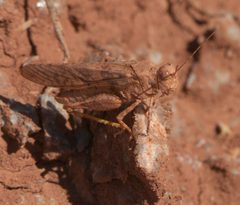
Circotettix rabula, the wrangler , is a large band-winged grasshopper in the Acrididae. It occurs across western North America from British Columbia to Manitoba and south to Arizona and New Mexico. The inhabits montane environments from foothills to timberline, with distinct occupying different altitudinal zones. It is rarely abundant and has minimal economic impact.
Pronunciation
How to pronounce Circotettix rabula: /sɜrkoʊˈtɛtɪks ˈræbjʊlə/
These audio files are automatically generated. While they are not always 100% accurate, they are a good starting point.
Identification
Distinguished from other Circotettix by combination of large size, pale greyish-brown coloration with darker markings, yellow wing disc with black band traces, and vertical with rounded vertex. C. rabula rabula occurs at lower elevations (foothills to timberline) while C. rabula alterior occurs at higher altitudes. Differs from other band-winged grasshoppers in its specific wing pattern and body proportions.
Images
Appearance
Large with pale greyish-brown general coloration and small darker markings. is vertical with rounded vertex. slender. margin of pronotum forms a rounded right angle; carina cut by two . Tegmina longer than body, speckled with spots sometimes forming indistinct bands. Wing disc yellow with traces of black band and spur; lateral margin of wing concave. Hind banded with brown and yellow on upper and inner surfaces. Hind tibiae buff, sometimes tinged with blue. Male length 45 mm; female 52 mm.
Habitat
Arid areas including gravelly clearings among pines, dry clay banks facing sun, usually associated with rivers and ravines. In Colorado, found from foothills to timberline; C. rabula alterior occurs at higher elevations than C. rabula rabula.
Distribution
Western North America: British Columbia to Manitoba (Canada), south through Wyoming, Colorado, Nebraska, Kansas, New Mexico, Oklahoma, and Arizona. Present in most areas of Colorado.
Seasonality
Nymphs overwinter and emerge from May to mid-June. appear mid-June and persist until early August.
Diet
Mixed feeder consuming moss and low-growing weeds. Specifically prefers loco (Astragalus/Oxytropis), vetch, sandwort, and bladderpod.
Life Cycle
pale yellow, about 30 per pod arranged in three or four columns; egg length 5.2 mm, diameter 1.1 mm. Five nymphal instars. Nymphs overwinter. Oviposition on bare flat areas or rolling open hills.
Behavior
Strong flier that commonly flushes ahead of sweep nets and flies long distances, making it difficult to collect with standard survey techniques. Exhibits behavioral with altitudinal variation in thermal strategies between .
Ecological Role
Herbivore in montane grassland and forest edge . Rarely becomes numerous; minimal competition with domestic livestock.
Human Relevance
Minimal economic impact; not considered a pest . Underrepresented in standard surveys due to strong that evades sweep net collection.
Similar Taxa
- Circotettix carlinianusSimilar and ; distinguished by specific wing patterns and body proportions
- Circotettix undulatus with overlapping range; differs in wing pattern and elevation preferences
- Dissosteira carolinaSimilar strong causing underrepresentation in surveys; larger size and different coloration
More Details
Altitudinal variation
Two recognized in Colorado: C. rabula rabula (foothills to timberline) and C. rabula alterior (higher elevations). show altitudinal variation in thermal strategies.
Survey limitations
Explicitly noted as underrepresented in Wyoming Distribution Atlas due to highly active characteristics that cause individuals to flush ahead of sweep nets.
Sources and further reading
- BugGuide
- Wikipedia
- GBIF taxonomy match
- iNaturalist taxon
- NCBI Taxonomy
- Catalogue of Life
- Grasshoppers of Colorado
- Grasshoppers of Colorado
- Grasshoppers of Colorado
- Species Records and Accounts
- Grasshoppers of Colorado
- Wyoming Distribution Atlas
- Altitudinal Variation in Thermal Behavior of the Grasshopper Circotettix rabula (Rehn & Hebard) from Central Colorado