
Leprus wheelerii
(Thomas, 1875)
Wheeler's Blue-winged Grasshopper
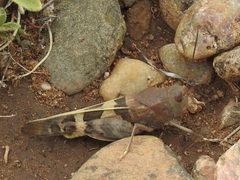
Leprus wheelerii is a band-winged grasshopper found in the southwestern United States and Mexico. The exhibits a notable wing color dimorphism: most display blue wings, but a yellow-winged morph occurs in Luna County, New Mexico. This feeds primarily on creosote bush (Larrea tridentata) and is an important component of Chihuahuan Desert , contributing to , soil nutrient cycling, and plant growth stimulation.
Identification
Distinguished from other Leprus by blue or yellow hindwings in . The yellow-winged morph in Luna County, New Mexico differs from typical blue-winged found elsewhere in the range. As a member of the tribe Hippiscini, it shares band-winged grasshopper characteristics with related .
Images
Habitat
Northern Chihuahuan Desert, specifically arid regions with creosote bush (Larrea tridentata) vegetation. Documented from bajada slopes on the north side of mountains at approximately 1400 m elevation in Luna County, New Mexico.
Distribution
Southwestern United States (Arizona, Colorado, New Mexico) and Mexico. Specifically documented from Luna County, New Mexico at the base of the Florida Mountains in the northern Chihuahuan Desert.
Seasonality
Emerges annually in spring.
Diet
Feeds primarily on creosote bushes (Larrea tridentata).
Host Associations
- Eutrombidium locustarum - microparasite (mite)Parasitic mite found on wings, , neck, and legs; ingests . rate of 41.8% observed in 2023 study.
- Wolbachia pipientis - endosymbiontAlpha-proteobacterium; rate of 46.8% observed. Evidence for both vertical and between and .
Life Cycle
in spring; specific developmental stages not detailed in available sources.
Behavior
Yellow-winged morph in Luna County may use wing coloration for (reduced energy absorption compared to dark wings) and homochromy (camouflage with yellow-tan desert soil for avoidance).
Ecological Role
Adds significant to desert . Enriches soil by facilitating breakdown of organic nutrients through cellulose degradation. Stimulates plant growth through combination of acids from crop and with auxin. Serves as component for . Can become agricultural pest when exceed regional .
Human Relevance
Potential agricultural pest when densities are high. Subject of ecological research on - relationships and color .
Similar Taxa
- Leprus cyaneusAnother blue-winged Leprus ; L. wheelerii distinguished by distribution and specific wing color morphs.
- Leprus robustusCongeneric with overlapping range; morphological differences in body form and wing characteristics.
More Details
Parasite Research
A 2023 study of 79 specimens documented co- patterns with pipientis and Eutrombidium locustarum, with evidence for of Wolbachia between and parasitic mite.
Nomenclature Note
The epithet is sometimes spelled 'wheeleri' in older literature, but 'wheelerii' (Thomas, 1875) is the accepted spelling following standard orthographic conventions for Latinized patronymics.
Sources and further reading
- BugGuide
- GBIF taxonomy match
- iNaturalist taxon
- Catalogue of Life
- Grasshoppers of Colorado
- Grasshoppers of Colorado
- Meet a Male Mantis in a Patch of Blanket Flowers | Bug Squad
- Magical Mantis Moments | Bug Squad
- Bembicid Holdings | Entomology Research Museum
- Bug Eric: New Mexico Dragonfly Blitz - Day 4
- Infection Rate of Two Parasites Found in Leprus Wheeleri Captured in The Northern Chihuahuan Desert