
Leprus
Saussure, 1861
blue-winged grasshoppers
Species Guides
2- Leprus intermedius(Saussure's Blue-winged Grasshopper)
- Leprus wheelerii(Wheeler's Blue-winged Grasshopper)
Leprus is a of band-winged grasshoppers in the Acrididae, commonly known as blue-winged grasshoppers. The genus contains at least three described : L. elephas, L. intermedius (Saussure's blue-winged ), and L. wheelerii (Wheeler's blue-winged grasshopper). These grasshoppers are notable for their distinctive blue or yellow hindwings, which are concealed at rest but revealed during . They inhabit arid and semi-arid regions of western North America, particularly the Chihuahuan Desert.
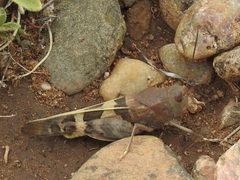
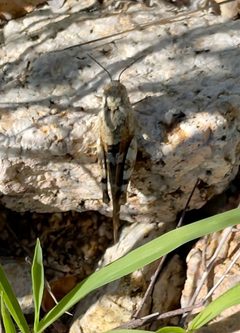
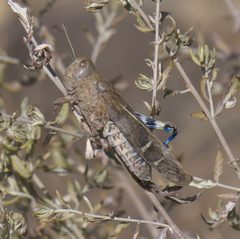
Pronunciation
How to pronounce Leprus: //ˈlɛp.rəs//
These audio files are automatically generated. While they are not always 100% accurate, they are a good starting point.
Identification
Leprus can be distinguished from other band-winged grasshoppers by their large size, robust body, and striking hindwing coloration—blue in L. intermedius and L. wheelerii, with L. wheelerii showing yellow-wing dimorphism in some . The hindwings are typically concealed beneath tegmina that match the ground coloration. L. intermedius and L. wheelerii are particularly similar and may require examination of male genitalia or geographic location for definitive identification.
Images
Habitat
Arid and semi-arid environments including desert grasslands, scrublands, and juniper-oak-pinyon woodlands. Specific records include alkaline flats, gypsum slopes, creosote bush-dominated bajadas, and sandy loam grasslands. Elevations range from approximately 1,400 m in desert basins to higher elevations in woodland transition zones.
Distribution
Western North America: documented from Arizona, California, Colorado, New Mexico, and Mexico. The is particularly associated with the Chihuahuan Desert, with L. wheelerii being the most common in that region. L. intermedius has been recorded in Colorado and New Mexico.
Seasonality
are active primarily in late summer and fall. L. wheelerii shows spring in the Chihuahuan Desert, with peak activity continuing through summer and into early autumn. Nymphs have been observed in September.
Diet
L. wheelerii feeds primarily on creosote bush (Larrea tridentata).
Life Cycle
with spring . Nymphs develop through summer, reaching adulthood by late summer or fall. L. wheelerii exhibits yellow-wing dimorphism in some , possibly serving thermoregulatory and camouflage functions.
Behavior
When disturbed, individuals reveal brightly colored hindwings during , then settle and quickly conceal the wings again. This flash coloration likely serves to startle . L. wheelerii can undergo , potentially becoming agricultural pests when is exceeded.
Ecological Role
Contributes significantly to regional and nutrient cycling. Facilitates breakdown of organic nutrients and stimulates plant growth through interactions between gut acids and plant . Serves as prey for various including spiders, birds, and reptiles. by (mites, bacteria, ) helps prevent agricultural devastation.
Human Relevance
L. wheelerii can become an agricultural pest when exceed regional . The has been studied for - relationships, particularly involving bacteria and Eutrombidium locustarum mites. Collectors and entomologists document for biodiversity surveys and ecological research.
Similar Taxa
- HippiscusAlso in tribe Hippiscini with banded wings, but differs in body proportions and hindwing coloration patterns
- TrimerotropisOverlapping distribution and band-winged , but Trimerotropis typically have different wing band patterns and lack the distinctive blue hindwings of Leprus
More Details
Parasite Associations
L. wheelerii pipientis (endosymbiont with 46.8% rate) and Eutrombidium locustarum mites (18% infection rate). Mites attach to wings, , neck, and legs, ingesting . Evidence exists for both vertical and horizontal Wolbachia transfer in this system.
Wing Dimorphism
A Luna County, New Mexico of L. wheelerii exhibits yellow-wing dimorphism alongside the typical blue-winged form. The yellow morph may provide thermoregulatory advantages and homochromy (background matching) with yellow-tan desert soils.
Sources and further reading
- BugGuide
- Wikipedia
- GBIF taxonomy match
- iNaturalist taxon
- NCBI Taxonomy
- Catalogue of Life
- Grasshoppers of Colorado
- Grasshoppers of Colorado
- Bug Eric: The Tarantula Hunt
- Bug Eric: New Mexico Dragonfly Blitz - Day 4
- Bug Eric: December 2015
- Zygophyllaceae | Beetles In The Bush
- Infection Rate of Two Parasites Found in Leprus Wheeleri Captured in The Northern Chihuahuan Desert