
Lestes congener
Hagen, 1861
Spotted Spreadwing
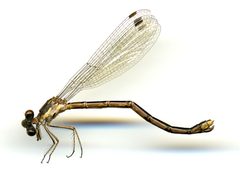
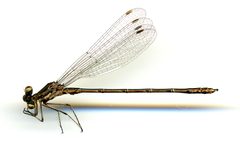
Lestes is a medium-sized in the Lestidae, commonly known as the spotted spreadwing. It is distinguished by two dark elongated spots on the latero- surface of its slaty gray . The exhibits in color: males have blue eyes while females have brown eyes. are active from late July to mid-September across much of North America. The species has been intensively studied for its adaptations to prairie environments, including with and highly synchronous development.
Pronunciation
How to pronounce Lestes congener: /ˈlɛstɛs ˈkɒndʒənər/
These audio files are automatically generated. While they are not always 100% accurate, they are a good starting point.
Identification
The two dark elongated spots on the latero- are diagnostic and give the its . Distinguished from other Lestes species by this spotted pattern combined with the slaty gray thoracic coloration. The in color (blue males, brown females) is a useful field character. The 45-degree wing posture at rest separates it from pond damselflies (Coenagrionidae) that fold wings together above the body.
Images
Habitat
Found at the banks of permanent and temporary ponds, flooded river banks, slow-moving water, marshes, and swamps. On the Canadian prairies, specifically associated with pond . Oviposition occurs in dry stems of emergent vegetation (Scirpus, Eleocharis obtusa) on dry land 0.5–3 m from the water's edge.
Distribution
Widespread throughout North America, including Canada and the United States except the southeastern states. Documented from New York State, the Canadian prairies, and Vermont.
Seasonality
period from late July to mid-September. Hatching is highly synchronous when temperatures exceed approximately 5°C. Adult is synchronous. Sexual maturation requires approximately 3 weeks after emergence.
Host Associations
- Scirpus - oviposition substratedry stems used for -laying
- Eleocharis obtusa - oviposition substratedry stems on land 0.5–3 m from water's edge
Life Cycle
Overwinters in the stage with a just before blastokinesis; during diapause eggs are extremely to low temperatures and desiccation. Post-diapause embryonic development can occur near 0°C but requires wetting as ponds fill in spring. Hatching is highly synchronous when temperature exceeds ~5°C. Larval development is rapid, completed in approximately 50 days. is synchronous. Sexual maturation requires 3 weeks.
Behavior
Larvae exhibit consistent individual activity levels (behavioral ) across different physiological states and cues, with activity reduced only in response to familiar predator cues. Larval behavioral type does not predict , indicating behavioral decoupling during ontogeny. engage in tandem oviposition with contact guarding; pairs form away from water and fly to oviposition sites. Some copulations occur at or near oviposition sites with immediate oviposition afterward. Females may complete oviposition alone after mate desertion, most commonly in late afternoon when few lone males remain.
Similar Taxa
- Other Lestes speciesL. distinguished by the two dark elongated spots on the latero- ; other spreadwings lack this specific spotted pattern or have different thoracic coloration.
- Coenagrionidae (pond damselflies)Lestidae hold wings at 45 degrees to body at rest; Coenagrionidae fold wings together above the .
More Details
Prairie Adaptations
The shows specific adaptations to rigorous prairie conditions: diapausing to desiccation and cold, highly synchronous hatching and timed to brief favorable periods, and rapid larval development.
Oviposition Substrate Specificity
Multiple pairs may use single stems over time, with placed singly in lines of incisions down the stem length. Less than 1% of stem surface area typically shows incision scars.
Sources and further reading
- BugGuide
- Wikipedia
- GBIF taxonomy match
- iNaturalist taxon
- NCBI Taxonomy
- Catalogue of Life
- How Many Species of Moths at Bohart Museum's Moth Night? | Bug Squad
- Bug Eric: Bosque del Apache National Wildlife Refuge
- Two New Gecko Species Discovered in Vietnam, One Named After Herpetologist Prof. Dr. Thomas Ziegler
- What Gives This Butterfly Species the Only Blue Wings in its Subtribe?
- For Ash-Dependent Insects, Some Plants Make Good Alternatives—But Others Don't
- Steel-blue cricket-hunters steal lives: Steel-blue cricket-hunters, Chlorion aerarium — Bug of the Week
- Oviposition behavior and substrate utilization byLestes congener(Odonata: Lestidae)
- THE LIFE HISTORY OF LESTES CONGENER (ODONATA: ZYGOPTERA) ON THE CANADIAN PRAIRIES
- Larval behavioral syndrome does not affect emergence behavior in a damselfly (Lestes congener)