
Argia bipunctulata
(Hagen, 1861)
seepage dancer
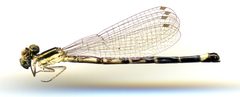
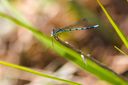
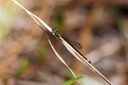
Argia bipunctulata, commonly known as the seepage dancer, is a of in the Coenagrionidae. It is native to North America and holds a conservation status of Least Concern () according to the IUCN, with a stable and no immediate threats to its survival. As a member of the Argia—the largest genus in the Argiinae—this species exhibits the characteristic "dancing" pattern typical of its .
Pronunciation
How to pronounce Argia bipunctulata: /ˈɑr.dʒi.ə baɪˌpʌŋk.tjʊˈleɪ.tə/
These audio files are automatically generated. While they are not always 100% accurate, they are a good starting point.
Images
Habitat
Associated with seepage areas and small streams, as indicated by its . Like other members of the Argia, it likely inhabits open areas near water bodies where it can perch on rocks, logs, or ground surfaces.
Distribution
Found in North America. Specific range details within this region are not documented in available sources.
Diet
Behavior
Like other "dancer" in the Argia, it likely exhibits a distinctive jerky pattern that contrasts with the direct flight of pond damselflies such as bluets and forktails. It probably perches flat on the ground, logs, or rocks with wings slightly raised above the when at rest.
Ecological Role
Functions as a in freshwater and riparian , contributing to insect control. As with other Odonata, its aquatic larval stage likely serves as prey for fish and other aquatic organisms, while may be preyed upon by birds and other .
Human Relevance
Serves as an for healthy freshwater . Its presence in seepage can signal adequate water quality and habitat integrity. The is of interest to odonate enthusiasts and researchers studying North American diversity.
Similar Taxa
- Argia vividaAnother North American Argia with similar size and general , though A. vivida males are bright blue while A. bipunctulata likely has different coloration patterns consistent with its specific epithet referring to two small spots.
- Argia moestaShares the "dancer" and preferences; mature male A. moesta develop distinctive pale blue pruinosity that distinguishes them from other Argia .
More Details
Taxonomic Research
The Argia has been intensively studied by odonate taxonomist Rosser Garrison, who has published multiple revisions of the genus (1994, 1996, 2007, 2015, 2017, 2018, 2019, 2022). These works provide the taxonomic foundation for understanding boundaries within this diverse genus of approximately 114 species.
Sources and further reading
- BugGuide
- Wikipedia
- GBIF taxonomy match
- iNaturalist taxon
- NCBI Taxonomy
- Catalogue of Life
- Dragonfly Enthusiasts, Unite! Open House Set Nov. 6 at Bohart Museum | Bug Squad
- Bohart Museum Open House: Dragonflies Rule! | Bug Squad
- Flameskimmers Bring Great Joy | Bug Squad
- Quick! Find the Damselfly! | Bug Squad
- Bug Eric: New Mexico Dragonfly Blitz - Day 3