
Pantala hymenaea
(Say, 1840)
spot-winged glider
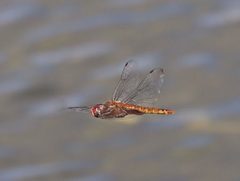
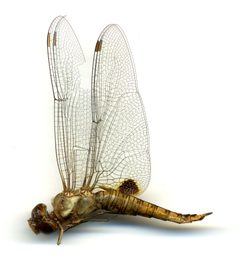
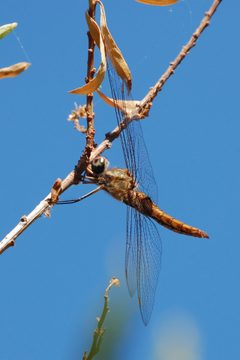
Pantala hymenaea, commonly known as the spot-winged glider, is a migratory in the Libellulidae native to the Americas. It is closely related to and resembles the wandering glider (Pantala flavescens), but is distinguished by a dark basal spot on the hindwing. The is a strong flier with a very large range across North, Central, and South America, and has been documented as one of five migratory dragonfly species monitored by the Migratory Dragonfly Partnership in North America.
Pronunciation
How to pronounce Pantala hymenaea: //pænˈtɑːlə hɪˈmɛnɪə//
These audio files are automatically generated. While they are not always 100% accurate, they are a good starting point.
Identification
Distinguished from the very similar wandering glider (Pantala flavescens) by the presence of a small dark brown spot at the base of the hindwing, which P. flavescens lacks. Females and immatures can be identified by the diagonal white marking on the . Overall size and proportions are nearly identical between the two .
Images
Appearance
Robust with cylindrical and broad hindwings. Length approximately 5 cm (2 in), wingspan approximately 7.5 cm (3 in). are red; is also red in breeding males. General body color is brown. Females and immatures have a diagonal white marking on the . Most distinctive feature is a small dark brown spot at the base of the hindwings.
Habitat
Breeds in temporary wetlands including flooded areas, pools, and garden ponds. Successful breeding is associated with the absence of fish, as nymphs feed in the open and are vulnerable to . As a migratory , utilize diverse during movement and can be encountered far from breeding sites.
Distribution
Widespread across the New World: six provinces in Canada (British Columbia, Manitoba, New Brunswick, Nova Scotia, Ontario, Québec), 45 states in the United States, 24 states in Mexico, the West Indies, Central America, and much of South America extending to Argentina. Presence in British Columbia and Manitoba may represent vagrant individuals rather than established breeding .
Seasonality
In North America, northward from tropical areas occurs in summer, with southward migration in fall. These movements likely represent different , though detailed remains poorly known. Active period corresponds with warmer months in temperate regions.
Diet
Aerial feeding on flying insects. Has been documented as a predator of Anopheles freeborni (western malaria mosquito), primarily hunting at dusk when mosquitoes swarm. decreases as light fades due to reliance on visual stimuli for prey detection.
Life Cycle
Breeding occurs in temporary water bodies. are laid in water; nymphs are aquatic that develop in the absence of fish . Developmental timing allows exploitation of ephemeral . emerge and may participate in migratory movements. time and precise developmental duration are not well documented.
Behavior
Strong flier capable of long-distance . Migratory movements follow seasonal patterns: northward in summer, southward in fall. Feeds aerially, with peak activity at dusk. Breeding occurs at temporary water bodies.
Ecological Role
Aquatic nymphs function as in temporary wetland . serve as aerial predators of mosquitoes and other flying insects, potentially contributing to natural control of mosquito including .
Human Relevance
Subject of citizen science monitoring through the Migratory Partnership. Potential value in mosquito control through on Anopheles freeborni. Listed as Least Concern by IUCN due to large range and common status.
Similar Taxa
- Pantala flavescensNearly identical in size and coloration; distinguished by the absence of a dark basal spot on the hindwing, which is present in P. hymenaea
More Details
Migration biology
Despite being a well-known migratory , detailed understanding of P. hymenaea routes, stopover sites, and connectivity remains limited compared to the extensively studied P. flavescens.
Breeding requirements
The apparent requirement for fish-free for successful breeding may limit distribution in areas with permanent water bodies containing predatory fish.
Sources and further reading
- BugGuide
- Wikipedia
- GBIF taxonomy match
- iNaturalist taxon
- NCBI Taxonomy
- Catalogue of Life
- Citizen Scientists Needed for the Migratory Dragonfly Partnership
- Pantala flavescens - Entomology Today
- This Dragonfly's Migratory Route is Even Longer than the Monarch Butterfly's
- How a Hydrogen Isotope Reveals a Dragonfly's Long-Distance Journey
- Insect Migration (Part 1) - Buglife Blog - Buglife
- Mudo Pryfed (Rhan 1) - Buglife Blog - Buglife