
Stylurus
Needham, 1897
Hanging Clubtails
Species Guides
10- Stylurus amnicola(Riverine Clubtail)
- Stylurus intricatus(brimstone clubtail)
- Stylurus ivae(Shining Clubtail)
- Stylurus laurae(Laura's clubtail)
- Stylurus notatus(Elusive Clubtail)
- Stylurus olivaceus(Olive Clubtail)
- Stylurus plagiatus(Russet-tipped Clubtail)
- Stylurus scudderi(Zebra Clubtail)
- Stylurus spiniceps(Arrow Clubtail)
Stylurus is a of in the Gomphidae, commonly known as hanging clubtails. The genus was established by Needham in 1897 and contains approximately 35 distributed across North America and Asia. Members are distinguished by their characteristic perching of hanging nearly vertically from vegetation. The genus has undergone taxonomic revision, with some species previously assigned to Stylurus now recognized as belonging to other genera such as Fukienogomphus. Nymphs of the Stylurus group were historically classified within the genus Gomphus before being recognized as a distinct lineage.
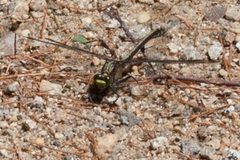
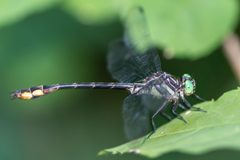
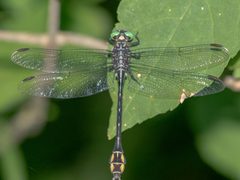
Pronunciation
How to pronounce Stylurus: /ˈstaɪljʊrəs/
These audio files are automatically generated. While they are not always 100% accurate, they are a good starting point.
Identification
Stylurus are distinguished from other Gomphidae by their unique perching posture—hanging nearly vertically with the pointing downward rather than the horizontal perching typical of most clubtails. This behavioral trait is consistent across the and serves as a reliable field mark for identification. Species-level identification requires examination of abdominal patterning, thoracic markings, and male terminal appendages.
Images
Habitat
Stylurus are associated with riverine and stream . are typically found in open areas near water bodies where they can perch on vegetation. Specific habitat associations vary by species, with some occupying large rivers and others smaller streams.
Distribution
The Stylurus occurs in North America and Asia. In North America, are distributed across the United States and southern Canada, with particular concentration in the eastern and central regions. The genus has been confirmed absent from Taiwan through taxonomic revision, with records formerly attributed to Stylurus now assigned to Fukienogomphus. Asian distribution includes China, Japan, and other parts of East Asia.
Seasonality
activity periods vary by and geographic location, generally occurring from late spring through summer. timing is tied to local hydrological and thermal conditions.
Behavior
The most notable of Stylurus is the characteristic perching posture that gives the group its . hang nearly vertically from vegetation, with the pointing downward, rather than adopting the horizontal perching posture typical of most . This behavior is consistent across and appears to be a -level trait.
Ecological Role
As with other , Stylurus function as in both aquatic (nymphal) and terrestrial () . Nymphs are aquatic predators that contribute to regulation of in freshwater systems. Adults are aerial predators of flying insects.
Human Relevance
Stylurus are of interest to odonate enthusiasts and researchers due to their distinctive perching . The serves as a subject for taxonomic and biogeographic studies. Some species may serve as indicators of riverine quality, though specific conservation applications are not well documented.
Similar Taxa
- GomphusHistorically, nymphs of the Stylurus group were classified within Gomphus. are distinguished by the vertical perching unique to Stylurus versus the horizontal perching typical of Gomphus.
- FukienogomphusTaxonomic revision has shown that Stylurus takashii is a junior synonym of Fukienogomphus prometheus, and the Stylurus does not occur in Taiwan. These genera were historically confused due to similar in females.
More Details
Taxonomic History
The Stylurus was established by Needham in 1897. Nymphs of this group were originally described within the genus Gomphus, with Walker (1928) providing the first detailed study of Stylurus group nymphs based on Canadian material. Recent taxonomic work has clarified that Stylurus is restricted to North America and parts of Asia, with previous Asian records from Taiwan now assigned to Fukienogomphus.
Species Diversity
The contains approximately 35 described , including notable North American species such as Stylurus amnicola (Riverine Clubtail), S. flavipes (River Clubtail), S. intricatus (Brimstone Clubtail), S. ivae (Shining Clubtail), S. notatus (Elusive Clubtail), S. olivaceus (Olive Clubtail), S. plagiatus (Russet-tipped Clubtail), S. scudderi (Zebra Clubtail), and S. spiniceps (Arrow Clubtail).
Sources and further reading
- BugGuide
- Wikipedia
- iNaturalist taxon
- NCBI Taxonomy
- Catalogue of Life
- September | 2022 | Beetles In The Bush
- Insecta | Beetles In The Bush | Page 5
- science | Beetles In The Bush | Page 5
- predator avoidance | Beetles In The Bush
- Crambidae | Beetles In The Bush
- The Ecology and Distribution of Stylurus spiniceps (Walsh, 1862) (Odonata: Gomphidae)
- THE NYMPHS OF THE STYLURUS GROUP OF THE GENUS GOMPHUS WITH NOTES ON THE DISTRIBUTION OF THIS GROUP IN CANADA. (ODONATA)
- Variation in Fukienogomphus prometheus (Lieftinck, 1939) reveals Stylurus takashii (Asahina, 1966) as a junior synonym, with discussion on the status of F. choifongae Wilson & Tam, 2006 (Odonata: Gomphidae)