
Phanogomphus cavillaris
(Needham, 1902)
Sandhill Clubtail, Brimley's Clubtail
Species Guides
1- Phanogomphus cavillaris brimleyi(Brimley's Clubtail)
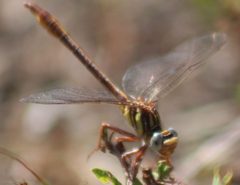
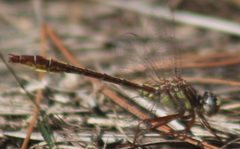
Phanogomphus cavillaris, the sandhill clubtail, is a clubtail to the Southeastern United States. It inhabits dry, sandy, scrub-like near streams or lakes. The is distinguished from similar by the straight occiput line between the and a dark band across the . Two are recognized: P. c. cavillaris in Peninsular Florida and P. c. brimleyi in the Florida Panhandle, Southern Alabama, and North Carolina.
Pronunciation
How to pronounce Phanogomphus cavillaris: //ˌfænəˈɡɒmfəs kəˈvɪlərɪs//
These audio files are automatically generated. While they are not always 100% accurate, they are a good starting point.
Identification
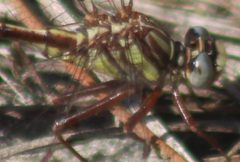
Most reliably distinguished from the cypress clubtail (P. minutus) by the straight occiput line between the ; P. minutus has a slightly curved, lobed occiput line and an entirely pale yellowish without a dark band. The straight occiput line is the most useful field character. Other morphological and microanatomical differences exist but require closer examination.
Images
Appearance
Medium-sized clubtail with yellow and dark patterning typical of the Phanogomphus. terminates in an enlarged club. are separated, positioned farther apart than in most Anisoptera. has a dark band across it. differ in abdominal coloration: P. c. cavillaris has dull yellowish or brownish abdominal tip with roughly uniform yellow body shading; P. c. brimleyi has brighter, more conspicuous yellow on the tail.
Habitat
Dry, sandy, lightly vegetated scrub-like located near streams or lakes. Requires proximity to aquatic systems despite the terrestrial appearance of habitat.
Distribution
to the Southeastern United States. Range extends from Central Peninsular Florida north of Lake Okeechobee to Southern Alabama, with an isolated in West Palm Beach, Florida, and another extremely isolated population in Bladen County, North Carolina.
Similar Taxa
- Phanogomphus minutusNearly identical general patterning and preference; distinguished by curved, lobed occiput line and entirely pale yellowish without dark band
More Details
Subspecies
Two recognized. P. c. cavillaris occurs in Peninsular Florida north of Lake Okeechobee and West Palm Beach. P. c. brimleyi (Brimley's clubtail) occurs in the Florida Panhandle, Southern Alabama, and Bladen County, North Carolina. The isolated North Carolina of P. c. brimleyi represents a significant disjunction from the main range.