
Octogomphus specularis
(Hagen, 1859)
Grappletail, Club-tailed dragonfly
Octogomphus specularis, commonly known as the grappletail or club-tailed , is the sole in its . It is a North American dragonfly distinguished by a club-like widening at the end of its . Larvae are specialized to lake outlet streams, where warmer thermal conditions support development at the northern range limit. The species has a three-year and reaches its northernmost distribution in British Columbia, Canada.
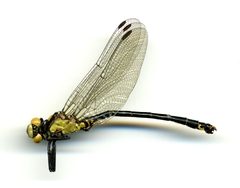
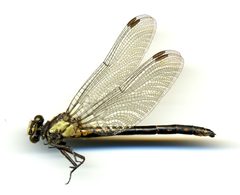
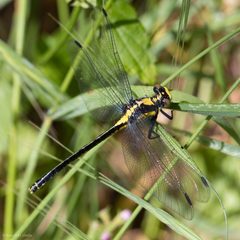
Pronunciation
How to pronounce Octogomphus specularis: /ˌɒktoʊˈɡɒmfəs ˌspɛkjʊˈlɛərɪs/
These audio files are automatically generated. While they are not always 100% accurate, they are a good starting point.
Identification
Distinguished from other clubtail ( Gomphidae) by the pronounced club-like expansion at the tip. The Octogomphus is , so identification to level follows from correct genus assignment. Separation from other Gomphidae genera requires examination of abdominal club and possibly genitalia. Larvae are found exclusively in lake outlet streams, a association that aids field identification.
Images
Appearance
Medium-sized with a distinct club-like widening at the end of the , the feature that gives the its . As a member of Gomphidae, it possesses the typical clubtail with widely separated on the . have the large characteristic of dragonflies, with up to 30,000 per eye covering most of the head. Wing venation and coloration patterns consistent with Gomphidae.
Habitat
Larvae are restricted to lake outlet streams, where they inhabit lotic environments receiving water from lakes. These streams provide thermally favorable conditions—documented as 37% warmer (4.4–7.2°C higher) than inflow streams—along with stable substrates and buffered discharge variation. The warmer thermal regime at lake outflows provides sufficient for larval development, particularly important at the northern range limit. occur in the vicinity of these stream systems.
Distribution
North American with range extending from the United States into Canada. At its northern range limit in British Columbia, Canada, the species is known from only seven occurrences. GBIF records indicate presence in Middle America and North America. The species demonstrates a lake outlet stream specialization that limits its distribution to areas with appropriate hydrological conditions.
Life Cycle
Three-year based on three distinct groupings of larval sizes observed in study . Larval development occurs in lake outlet streams where thermal conditions support growth rates necessary for completion of development. Duration of period not documented in available sources.
Behavior
are aerial utilizing both sit-and-wait and active hunting strategies. They specialize in capturing flying prey. Like other dragonflies, they possess nearly 360-degree vision and are extra sensitive to small wavelengths. Larval abundance has been observed to decrease with increasing distance from the lake outlet in some streams, though this pattern was not consistent across all studied streams.
Similar Taxa
- Other Gomphidae (clubtail dragonflies)Share -level characteristics including clubbed or expanded tips; require careful examination of club and genitalia for differentiation
More Details
Thermal ecology at range limits
Research indicates that lake outlet streams provide critical thermal buffering that enables O. specularis to persist at its northern range limit. The 4.4–7.2°C thermal advantage over inflow streams translates to substantially greater accumulation, which appears necessary for successful larval development in this region.
Genus monotypy
Octogomphus contains only one , O. specularis, making it unusual among North American gomphid . This status may reflect specialized ecological requirements, particularly the lake outlet stream association.