
Clathroneuria
Banks, 1913
Species Guides
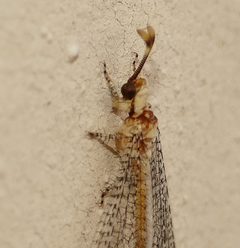
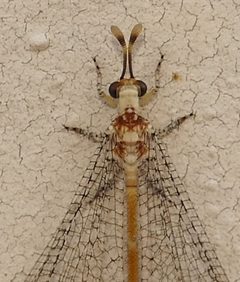
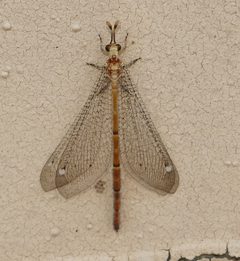
3Clathroneuria is a of antlions in the Myrmeleontidae, established by Banks in 1913. The genus contains five described distributed in North America. Species were described between 1898 and 1970, with several named by Banks in 1938. Like other antlions, are aerial while larvae are ground-dwelling predators that construct pit traps to capture prey.
Pronunciation
How to pronounce Clathroneuria: /klæθroʊˈnʊəriə/
These audio files are automatically generated. While they are not always 100% accurate, they are a good starting point.
Identification
Distinguished from other Myrmeleontidae by wing venation patterns, particularly the arrangement of crossveins forming a clathrate (lattice-like) network in the costal and subcostal regions, which gives the genus its name. have long, narrow wings with dense venation. Larvae possess the enlarged, sickle-shaped characteristic of antlions.
Images
Habitat
Arid and semi-arid regions, including sandy soils suitable for larval pit construction. frequent vegetation in dry, open .
Distribution
North America; occur in western United States. Clathroneuria arapahoe and C. navajo were described from Colorado, C. westcotti from Oregon, and C. coquilletti and C. schwarzi have broader western distributions.
Life Cycle
Complete with , larva, pupa, and stages. Larvae are . occurs in a silken cocoon buried in soil.
Behavior
Larvae construct conical pit traps in loose, sandy substrate to capture small arthropods. are or , weak fliers often found resting on vegetation during daylight hours.
Ecological Role
Larvae function as sit-and-wait in soil , regulating of small arthropods. are aerial predators.
Human Relevance
No direct economic significance. Occasionally encountered by entomologists and naturalists in sandy . Larval pits may be observed in suitable substrates.
Similar Taxa
- MyrmeleonLarger with broader distribution; Clathroneuria distinguished by more elaborate wing venation with clathrate pattern in costal area
- BrachynemurusAnother Myrmeleontidae with similar form; Clathroneuria differs in wing venation details and typically smaller size
More Details
Etymology
name derived from Greek 'clathrus' (lattice, trellis) and 'neuria' (), referring to the distinctive reticulate wing venation.
Taxonomic history
Two (C. coquilletti and C. schwarzi) were originally described in other and later transferred to Clathroneuria.