
Chauliodes pectinicornis
(Linnaeus, 1763)
Summer Fishfly
Chauliodes pectinicornis, commonly known as the Summer , is a of fishfly in the Corydalidae native to eastern North America. First described by Carl Linnaeus in 1763, this species has a notably wide distribution across eastern Canada and the United States. A distinctive ecological feature is its commensal relationship with Plecopteracoluthus downesi larvae, which complete their entire including on the fishfly's .
Pronunciation
How to pronounce Chauliodes pectinicornis: //kaɪˈlioʊdiːz ˌpɛktɪnɪˈkɔrnɪs//
These audio files are automatically generated. While they are not always 100% accurate, they are a good starting point.
Identification
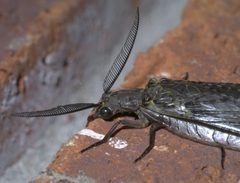
The pectinate of males are the most distinctive feature for identification within the Chauliodes. C. pectinicornis can be distinguished from the related Spring Fishfly (Chauliodes rastricornis) by its later seasonal activity period and subtle morphological differences in antennal structure. The specific epithet "pectinicornis" directly references the comb-like male antennae. are most reliably identified by examining male antennal structure; females have less dramatically modified antennae. Geographic distribution and seasonal timing (summer versus spring emergence for related species) provide additional supporting evidence for identification.
Images
Appearance
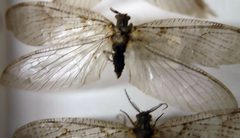
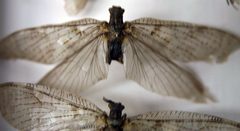
are medium to large-sized insects with elongated bodies typical of fishflies. Males possess conspicuously pectinate (comb-like or feathery) , from which the derives its name "pectinicornis." The antennae are notably branched, particularly in males, serving as a key diagnostic feature. Adults have large, membranous wings that are typically held roof-like over the body when at rest. The body is generally soft-bodied and somewhat flattened, with chewing mouthparts. Coloration tends toward brownish or grayish tones, though specific pattern details are not well documented in available sources.
Habitat
Associated with freshwater aquatic systems, particularly streams and rivers where larval development occurs. are often found near water sources in wooded or riparian areas. The requires clean, well-oxygenated water for larval development, indicating sensitivity to aquatic quality.
Distribution
Eastern North America, ranging from Maine in the northeastern United States south to Alachua, Liberty, and Santa Rosa counties in Florida, and westward to Kansas. The distribution spans eastern Canada and the eastern United States, representing one of the more broadly distributed in the region.
Seasonality
are active during summer months, hence the "Summer ." This distinguishes the from the Spring Fishfly (Chauliodes rastricornis), which emerges earlier in the year. The specific timing of adult activity varies with latitude but generally occurs during the warmer months of the year.
Host Associations
- Plecopteracoluthus downesi - commensalLarvae of this undergo their entire including on the of C. pectinicornis
Life Cycle
Aquatic larvae develop in freshwater , likely requiring one or more years to complete development based on patterns observed in related . Larvae are predatory, feeding on other aquatic . occurs in terrestrial or semi-terrestrial settings near the water's edge. are relatively short-lived and do not feed, focusing on . The specific duration of larval development and number of per year are not well documented.
Behavior
are typically or , being attracted to lights. They are relatively weak fliers compared to some related insects. The exhibits a notable commensal relationship in which Plecopteracoluthus downesi larvae live on the adult 's body, completing their development there. This association represents a specialized and unusual form of or commensalism.
Ecological Role
Larvae function as in freshwater , contributing to the regulation of aquatic . serve as for the commensal Plecopteracoluthus downesi, potentially facilitating the of this smaller . The species is also a food source for various predators including fish, birds, and other insects. As an indicator of clean water conditions, the species may serve as a bioindicator of aquatic quality.
Human Relevance
are sometimes attracted to lights at night and may be encountered near human dwellings in riparian areas. The has no documented economic importance as a pest or beneficial insect. Historical taxonomic significance as one of the earlier described North American insects (Linnaeus, 1763) gives it importance in entomological history.
Similar Taxa
- Chauliodes rastricornisThe Spring Fishfly is the most similar congeneric , distinguished primarily by earlier seasonal (spring versus summer) and subtle differences in male antennal structure. Geographic overlap exists, making seasonal timing a useful field character.
- Corydalus cornutusThe Eastern Dobsonfly is a larger relative in the same with dramatically different male , including elongated in males that are absent in Chauliodes .
More Details
Taxonomic History
First described by Carl Linnaeus in 1763 in his work Centuria Insectorum, making it one of the earliest described North American insects. The has undergone several taxonomic revisions, with multiple synonymies proposed and debated. The relationship between North American and the European Cladius pectinicornis (sometimes applied to the Bristly Rose Slug sawfly) has caused some nomenclatural confusion in older literature, though these represent entirely unrelated insects in different orders.
Ectocommensalism
The relationship with Plecopteracoluthus downesi represents a rare documented case of commensalism involving aquatic insects. The larvae benefit from transportation and possibly feeding opportunities on organic material on the 's body, while the fishfly appears unaffected. This association was noted in ecological literature as an unusual natural history observation.
Sources and further reading
- BugGuide
- Wikipedia
- GBIF taxonomy match
- iNaturalist taxon
- NCBI Taxonomy
- Catalogue of Life
- Bug Eric: Wasp Wednesday: Bristly Rose Slug
- Archive — Bug of the Week
- Rosie defoliators: Roseslug sawfly, Endelomyia aethiops, Curled rose sawfly, Allantus cinctus, and Bristley rose sawfly, Cladius pectinicornis — Bug of the Week
- Rosie defoliators - Roseslug sawfly, Endelomyia aethiops, Curled rose sawfly, Allantus cinctus, and Cladius pectinicornis — Bug of the Week