
Acoloithus falsarius
Clemens, 1860
Clemens' false skeletonizer
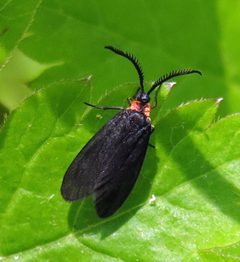
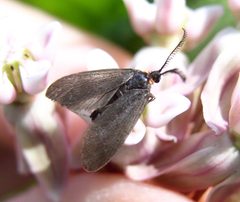
Acoloithus falsarius, commonly known as Clemens' false skeletonizer, is a small zygaenid native to North America. measure 9–10 mm in body length with a wingspan of approximately 15 mm. The is the type species of Acoloithus and has been assigned Hodges number 4629. In Florida, it produces two annually.
Pronunciation
How to pronounce Acoloithus falsarius: //ˌækəˈlaɪθəs fɔlˈsɛərɪəs//
These audio files are automatically generated. While they are not always 100% accurate, they are a good starting point.
Identification
Distinguished from similar zygaenid by the combination of small size (15 mm wingspan), black coloration with a broken orange collar, and association with grape- plants. The broken (interrupted) orange collar pattern is a key visual marker separating it from related with complete or absent collar markings.
Images
Habitat
Associated with supporting its larval plants in the grape (Vitaceae), including areas with Vitis (grape) and Ampelopsis .
Distribution
North America; recorded from the United States including Vermont and Florida.
Seasonality
In Florida, two per year have been documented. Specific periods in other parts of the range are not well documented.
Diet
Larvae feed on of Vitis (grapes) and Ampelopsis.
Host Associations
- Vitis - larval food plantmultiple
- Ampelopsis - larval food plantmultiple
Life Cycle
in Florida (two per year). Complete with , larval, pupal, and stages; specific details of site and stage not documented.
Ecological Role
Larval herbivore on Vitaceae; may contribute to leaf damage on grape and related , though specific ecological impacts have not been quantified.
Human Relevance
Potential minor pest of grape due to larval feeding on Vitis ; Hodges number 4629 facilitates identification in North American surveys.
Similar Taxa
- Other ProcridinaeSimilar small size and zygaenid ; distinguished by the broken orange collar pattern and specific plant associations with Vitaceae
- Other Acoloithus speciesCongeneric may share general appearance; A. falsarius is the type species and can be distinguished by the specific broken collar pattern and documented range
More Details
Taxonomic history
Described by James Brackenridge Clemens in 1860. The authority is sometimes cited as 1861 in some sources. Serves as the type for the Acoloithus.
Observation frequency
Well-documented on citizen science platforms with over 1,000 observations, suggesting it is relatively common and detectable within its range.