
Lithacodes
Packard, 1864
slug caterpillar moths
Species Guides
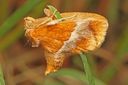
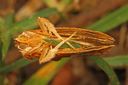
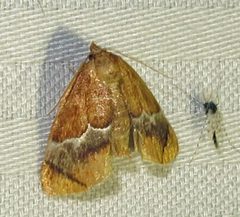
3- Lithacodes fasciola(yellow-shouldered slug)
- Lithacodes fiskeanus
- Lithacodes gracea(Graceful Slug Moth)
Lithacodes is a of slug caterpillar moths in the Limacodidae, established by Packard in 1864. The genus contains approximately five described distributed in North America. Larvae of this genus exhibit the characteristic slug-like form typical of Limacodidae, with reduced and a broad, flattened body adapted for slow, gliding movement.
Pronunciation
How to pronounce Lithacodes: //ˈlɪθəˌkoʊdiːz//
These audio files are automatically generated. While they are not always 100% accurate, they are a good starting point.
Identification
may be distinguished from other Limacodidae by genitalic and wing venation characters; -level identification often requires examination of genitalia. Larvae can be recognized by the slug-like form combined with specific color patterns: Lithacodes fasciola larvae have yellow lateral patches on a green background, while other species show different markings.
Images
Appearance
are small to medium-sized with relatively broad wings and compact bodies. Larvae have the distinctive slug-like of Limacodidae: body broad and flattened, reduced or modified, and locomotion achieved through a gliding motion rather than typical caterpillar crawling. Specific coloration and pattern vary by .
Habitat
Associated with deciduous forests and wooded areas where plants occur. Larvae feed on leaves of various hardwood trees and shrubs.
Distribution
North America, with records from the eastern and central United States including Vermont.
Seasonality
are active during the warmer months; exact periods vary by and latitude. Larvae present during spring and summer.
Diet
Larvae feed on leaves of hardwood trees including oak (Quercus), beech (Fagus), and other woody plants. Specific associations vary among .
Host Associations
- Quercus - larval food plant
- Fagus - larval food plant
Life Cycle
Complete with , larva, pupa, and stages. Larvae are the feeding stage and possess stinging or urticating setae typical of Limacodidae. occurs in a cocoon.
Behavior
Larvae move with a characteristic gliding motion due to their modified body form. When disturbed, some limacodid larvae may arch their bodies or display urticating spines.
Ecological Role
Larvae function as herbivores on deciduous trees, contributing to nutrient cycling and serving as prey for and other natural enemies. Their stinging spines provide defense against .
Human Relevance
Larvae can deliver painful stings through urticating spines, making them a minor medical concern. The yellow-shouldered slug (Lithacodes fasciola) is the most frequently encountered and is occasionally reported for its sting.
Similar Taxa
- IsaBoth are Limacodidae with slug-like larvae; Isa often have more contrasting color patterns and different wing patterns.
- EucleaAnother Limacodidae with similar larval ; Euclea larvae often have more prominent and different coloration.
- ParasaLimacodidae with similar slug-like larvae; Parasa typically show different wing patterns and larval coloration.
More Details
Species Diversity
The contains five described : Lithacodes fasciola, L. fiskeana, L. gracea, L. graefii, and L. fiskeanus (the latter may be a synonym or variant spelling of L. fiskeana). Lithacodes fasciola is the most widespread and commonly observed.
Taxonomic History
Established by Packard in 1864. The has remained relatively stable taxonomically, though -level synonymy and have required clarification.