
Dalcerides ingenita
(Edwards, 1882)
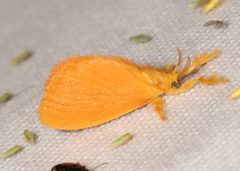
Dalcerides ingenita is a in the Dalceridae described by Henry Edwards in 1882. It occurs in the southwestern United States and Mexico, where are active from late spring through early autumn. The participates in a mimetic complex with beetles of the Lycus. Larvae feed on specific oak and manzanita species.
Pronunciation
How to pronounce Dalcerides ingenita: //dælˈsɛrɪdiːz ɪnˈdʒɛnɪtə//
These audio files are automatically generated. While they are not always 100% accurate, they are a good starting point.
Identification
participate in a mimetic complex modeled on Lycus loripes and Lycus simulans, likely sharing the orange-and-black coloration of these net-winged beetles. The similar geometrid Eubaphe unicolor occurs in the same mimetic complex in Arizona.
Images
Habitat
Subtropical moist forests, subtropical dry forests, warm temperate moist forests, warm temperate dry forests, and warm temperate thorn steppe.
Distribution
United States: southeastern Arizona north to Flagstaff, southwestern Texas. Mexico.
Seasonality
Arizona: late April to September. Mexico: July to December.
Diet
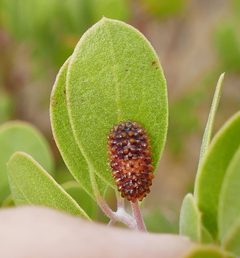
Larvae feed on Arctostaphylos pungens (pointleaf manzanita), Quercus emoryi (Emory oak), and Quercus oblongifolia (Mexican blue oak).
Behavior
Similar Taxa
- Eubaphe unicolorGeometrid in the same mimetic complex in Arizona, also modeled on Lycus beetles
- Lycus loripesNet-winged beetle that serves as a model for the mimetic complex
- Lycus simulansNet-winged beetle that serves as a model for the mimetic complex
More Details
Taxonomic note
iNaturalist lists this under Limacodidae, but authoritative sources (GBIF, Catalogue of Life, NCBI) place it in Dalceridae.
Mimicry complex
The involvement of both a dalcerid and a geometrid moth in the same Lycus mimicry complex in Arizona represents an unusual case of cross- convergence.