
Lyonetia prunifoliella
(Hübner, 1796)
Blackthorn Blister Moth
Lyonetia prunifoliella is a small leaf-mining in the Lyonetiidae. have a wingspan of 9–10 mm and are active in autumn, before reappearing in spring. The larvae create distinctive leaf mines on a broad range of plants in the Rosaceae family, including Prunus, Betula, Crataegus, and Sorbus . The species is widespread across northern Europe and Asia, with also established in North America.
Pronunciation
How to pronounce Lyonetia prunifoliella: //laɪəˈniːʃə pruːnɪfoʊliˈɛlə//
These audio files are automatically generated. While they are not always 100% accurate, they are a good starting point.
Identification
are most readily identified by their small size (9–10 mm wingspan) and autumn period followed by . The leaf mines are highly diagnostic: larvae initially create a narrow, winding corridor with a broad reddish-brown line, which later expands into a wide, full-depth blotch, often positioned against the leaf margin. An initial cavity around the oviposition site frequently leaves a hole in the leaf. The larva may abandon its mine and initiate a new one, sometimes on a different leaf. These mines can be distinguished from those of other Lyonetia by plant association and mine .
Images
Appearance
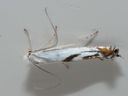
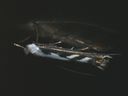
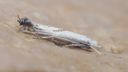
are minute with a wingspan of 9–10 mm. The specific wing coloration and pattern are not described in available sources, though Lyonetiidae typically exhibit subdued coloration.
Habitat
Occurs in environments supporting its diverse plants, including woodlands, hedgerows, orchards, and gardens. Host plants include birch (Betula pendula, B. pubescens), hawthorn (Crataegus monogyna), and various cultivated and wild Prunus . Specific microhabitat preferences for are not documented.
Distribution
Present across most of Europe except Ireland, the Iberian Peninsula, and Mediterranean islands. Recorded in Turkey, Kazakhstan, south-eastern Siberia, the Russian Far East, Japan, and North America. Previously considered extinct in Great Britain but has been recently recorded there again. GBIF records confirm presence in Belgium.
Seasonality
are on wing in September, then overwinter and reappear in spring. The precise timing of larval activity is not specified but presumably follows -laying in spring.
Diet
Larvae feed as leaf miners on Betula pendula, Betula pubescens, Chaenomeles japonica, Cotoneaster integerrimus, Crataegus monogyna, Cydonia oblonga, Mespilus germanica, Prunus armeniaca, Prunus cerasifera, Prunus dulcis, Prunus mahaleb, Prunus persica, Prunus spinosa, Pyrus communis, and Sorbus . feeding habits are not documented.
Host Associations
- Betula pendula - larval
- Betula pubescens - larval
- Chaenomeles japonica - larval
- Cotoneaster integerrimus - larval
- Crataegus monogyna - larval
- Cydonia oblonga - larval
- Mespilus germanica - larval
- Prunus armeniaca - larval
- Prunus cerasifera - larval
- Prunus dulcis - larval
- Prunus mahaleb - larval
- Prunus persica - larval
- Prunus spinosa - larval
- Pyrus communis - larval
- Sorbus - larval
Life Cycle
are deposited on the underside of leaves. A cavity develops around the oviposition site, often resulting in a hole. The larva mines first as a narrow corridor, then widens into a blotch mine. The larva may leave its mine and start a new one. details are not specified in available sources. emerge in September, overwinter, and appear again in spring.
Behavior
overwinter, a relatively uncommon trait among small . Larvae are leaf miners that may abandon their initial mine and initiate a new one, sometimes on a different leaf. This may represent a response to resource depletion or defensive plant responses.
Ecological Role
As a , larvae consume photosynthetic tissue and produce within leaf mines. The broad range across Rosaceae suggests a herbivore role within its . Specific ecological impacts or interactions with are not documented.
Human Relevance
The mines leaves of several cultivated fruit trees and shrubs including apricot (Prunus armeniaca), almond (Prunus dulcis), peach (Prunus persica), quince (Cydonia oblonga), medlar (Mespilus germanica), and pear (Pyrus communis), suggesting potential minor significance in horticulture. However, no specific economic impact has been documented. The species was considered extinct in Great Britain, and its rediscovery there carries conservation interest.
Similar Taxa
- Lyonetia lediAlso a leaf-mining Lyonetiid with similar mine ; historically confused or related, though L. ledi specializes on Rhododendron ferrugineum in Alpine and Ledum palustre/Gaylussacia in northern Europe. Distinguished by plant association and geographic context.
- Other Lyonetia speciesShare -level traits of small size and leaf-mining larvae; require examination of mine , plant, and genitalia for definitive identification.
More Details
Subspecies
Two are recognized: L. p. prunifoliella (nominate) and L. p. malinella (Matsumura, 1907) from Japan.
Conservation note
The was considered extinct in Great Britain but has been recently recorded there again, indicating possible overlooked persistence or recolonization.