
Acrolepiopsis assectella
(Zeller, 1839)
Leek Moth, Onion Leaf Miner
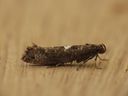
Acrolepiopsis assectella, commonly known as the leek or onion leaf miner, is a herbivore native to Europe and Siberia that has become an pest in North America. It is a significant agricultural pest of Allium crops including garlic, leek, onion, and chives, capable of causing up to 40% crop damage. The has expanded its range from initial detections in the Ottawa area in 1993 to much of eastern Canada and the northeastern United States. Its is temperature-dependent, with 1–3 per year possible depending on climate.


Pronunciation
How to pronounce Acrolepiopsis assectella: //ˌækroʊˌlɛpiˈɒpsɪs əˌsɛkˈtɛlə//
These audio files are automatically generated. While they are not always 100% accurate, they are a good starting point.
Images
Habitat
Agricultural and natural environments containing plants in the Allium. In its native range, occurs in areas where wild and cultivated Allium grow. In North America, established in agricultural regions producing garlic, leek, and onion crops. The species requires access to alternative host plants for first- to complete multiple generations within a growing season.
Distribution
Native to Europe (widespread including Austria, Belarus, Belgium, Czech Republic, Denmark, Estonia, Finland, France, Germany, Greece, Hungary, Italy, Latvia, Lithuania, Netherlands, Norway, Poland, Portugal, Romania, Russia, Serbia, Slovakia, Slovenia, Spain, Sweden, Switzerland, Ukraine, United Kingdom) and Siberia (Eastern Siberia, Western Siberia, Far East, Central and Northern Russia). Also recorded in Asia (Armenia, Azerbaijan, Georgia, Kazakhstan, Kyrgyzstan, Mongolia), North Africa (Algeria), and Hawaii (misidentification of A. sapporensis). in North America: established in Canada (Ontario, Quebec, New Brunswick, Nova Scotia, Prince Edward Island) and USA (New York, Vermont), with potential for further spread throughout southeastern Canada, eastern United States, Pacific Northwest coastal regions, interior southern British Columbia, and north-central Mexico.
Seasonality
In eastern Ontario, three periods occur: spring (overwintered ), early summer (first ), and late summer (second generation). At a threshold of 6–7°C, development from to adult requires approximately 445–630 . In cooler climates such as Sweden, two generations per year are possible during warm summers; three generations are possible in eastern Ontario depending on ambient temperatures. Each generation takes 3–6 weeks in the field.
Diet
herbivore feeding exclusively on in the Allium ( Alliaceae/Amaryllidaceae). Larvae feed internally on leaves and bulbs of plants. Documented hosts include leek (Allium porrum), garlic (Allium sativum), onion (Allium cepa), chives (Allium schoenoprasum), and wild Allium species. Oviposition preference and larval survival decline as phylogenetic distance from the preferred host Allium ampeloprasum var. porrum increases.
Host Associations
- Allium porrum - primary leek; preferred for oviposition and larval development
- Allium sativum - garlic; significant economic damage documented in North America
- Allium cepa - onion; affected in invaded range
- Allium schoenoprasum - chives; accepted for oviposition though affects preference
- Allium ampeloprasum - preferred wild progenitor of leek; reference for phylogenetic distance studies
Life Cycle
Holometabolous with , larva, pupa, and stages. Eggs laid on plant foliage. Larvae are internal feeders, mining leaves and sometimes entering bulbs. occurs in silken cocoons on host plants or in surrounding debris. stage is the adult. In eastern Ontario, three are possible with overlapping periods; in cooler regions, one to two generations occur. Development rate is strongly temperature-dependent with linear models applicable for phenological prediction.
Behavior
Females are monogamous: sexual receptivity is stimulated by male but inhibited after mating. The presence of a in the bursa copulatrix and spermatozoa in the spermatheca serve as signals terminating female sexual receptivity. Oviposition is stimulated by volatile sulfur compounds from plants, particularly thiosulfinates (labile compounds) rather than stable disulfides. Females prefer to oviposit on plants with larger when given equivalent host . Mated females require insemination for production; the presence of mobile eupyrene spermatozoa in the receptaculum seminalis stimulates and increases oocyte production, with stimulation intensity proportional to spermatozoa quantity. Male secretions in the bursa copulatrix can weakly stimulate oviposition for a few days, but sustained oviposition requires spermatozoa in the spermatheca.
Ecological Role
Herbivore and agricultural pest. Serves as for including Diadromus pulchellus, a pupal parasitoid introduced for in North America. Native parasitoid in invaded regions may interact with introduced agents. Induces modified strategies in host plants (documented in leek).
Human Relevance
Significant economic pest of Allium crops, particularly affecting organic production systems. Can cause up to 40% crop damage to garlic, leek, and onion. Management strategies include application of reduced-risk foliar , as mechanical barriers, -based monitoring for timing interventions, trap cropping, and using introduced . programs combine multiple tactics with precise timing based on phenological models. Range expansion in North America presents ongoing risk to Allium producers.
Similar Taxa
- Acrolepiopsis sapporensisPreviously misidentified as A. assectella in Hawaii; distinct requiring careful morphological or molecular verification for accurate identification
More Details
Reproductive Physiology
Research demonstrates that neither sexual , male , nor genital introduction alter mature production; insemination is necessary. The only factor stimulating oocyte production is mobile eupyrene spermatozoa in the receptaculum seminalis, with signal transmission to cephalic centers likely via neural .
Chemical Ecology
Thiosulfinates—unstable sulfur compounds released when Allium tissues are damaged—are more effective oviposition stimulants than stable disulfides. This supports the hypothesis that labile compounds provide spatial-temporal information for location, contradicting earlier assumptions that disulfides are the primary attractants.
Invasion History
First recorded in Ottawa area, Canada in 1993. By 2010, established in eastern Ontario, southwestern Quebec, Prince Edward Island, and New York. Bioclimate modeling indicates high probability of survival throughout eastern North America and potential suitability in Pacific Northwest and north-central Mexico.
Management Tools
traps enable monitoring of periods for timing interventions. models with 6–7°C threshold allow prediction of life-cycle stages for precise application of or deployment of . Trap cropping can reduce deposition on primary crops by redistributing oviposition, though total egg numbers may remain similar in small- systems.
Sources and further reading
- BugGuide
- GBIF taxonomy match
- iNaturalist taxon
- NCBI Taxonomy
- Catalogue of Life
- Acrolepiopsis assectella . [Distribution map].
- Acrolepiopsis assectella . [Distribution map].
- Acrolepiopsis assectella . [Distribution map].
- Oviposition and feeding preference of Acrolepiopsis assectella Zell. (Lep., Acrolepiidae)
- Biology and development ofAcrolepiopsis assectella(Lepidoptera: Acrolepiidae) in eastern Ontario
- Modified Reproduction Strategy of Leek Allium porrum in Response to a Phytophagous Insect, Acrolepiopsis assectella
- Release and post-release monitoring ofDiadromus pulchellus, a pupal parasitoid of leek moth (Acrolepiopsis assectella)
- The parasitoid community associated with the invasive leek moth, Acrolepiopsis assectella (Zeller) (Lepidoptera: Acrolepiidae): can conservation biological control benefit an introduced classical biological control agent in North America?
- Behavioural events and host constituents involved in oviposition in the leek moth Acrolepiopsis assectella
- Actual and potential distribution ofAcrolepiopsis assectella(Lepidoptera: Acrolepiidae), an invasive alien pest ofAlliumspp. in Canada
- Behavioural events and host constituents involved in oviposition in the leek moth Acrolepiopsis assectella
- Trap cropping effect on oviposition behaviour of the leek moth Acrolepiopsis assectella and the diamondback moth Plutella xylostella
- Effect of temperature on development and activity periods of the leek moth Acrolepiopsis assectella Zell. (Lep., Acrolepiidae)
- Action des substances soufrées volatiles du poireau (Allium porrum) sur la ponte d'Acrolepiopsis assectella (Lepidoptera: Hyponomeutoïdea): prépondérance des thiosulfinates
- STIMULATION OF REPRODUCTIVE ACTIVITY OF FEMALES OF ACROLEPIOPSIS ASSECTELLA (LEPIDOPTERA: HYPONOMEUTOIDEA) BY THE PRESENCE OF EUPYRENE SPERMATOZOA IN THE SPERMATHECA