
Orthotaenia undulana
(Denis & Schiffermüller, 1775)
Dusky Leafroller Moth
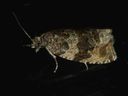
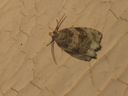
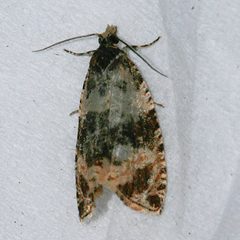
Orthotaenia undulana is a small tortricid with a wingspan of 15–20 mm, distributed across the . The exhibits cryptic coloration that provides camouflage against surfaces, resembling bird droppings when at rest. are active from May through mid-August in western Europe, with timing varying across its range. Larvae feed on a diverse range of woody plants including honeysuckle, Vaccinium, pine, and birch.
Pronunciation
How to pronounce Orthotaenia undulana: /ɔr.θoʊˈtiː.niə ˌʌn.djuˈlæ.nə/
These audio files are automatically generated. While they are not always 100% accurate, they are a good starting point.
Identification
The combination of small size (15–20 mm wingspan), brownish-gray forewings with a distinct light cross-band, and white wing tips with brown markings distinguishes this from many similar tortricids. The bird-dropping camouflage posture when at rest is a behavioral cue that supports identification. The light hindwings contrast with darker forewing patterns.
Images
Habitat
Associated with supporting its larval plants: woodlands, scrublands, and heathlands where honeysuckle, Vaccinium , pine, and birch occur. Specific microhabitat preferences for are not documented.
Distribution
. Documented presence in Belgium (including Brussels-Capital Region, Flemish Region, Walloon Region, and Antwerpen province). Distribution extends across Europe; precise limits require further documentation.
Seasonality
period May to mid-August in Belgium and the Netherlands. Timing varies elsewhere in the range.
Diet
Larvae feed on honeysuckle (Lonicera), Vaccinium, pine (Pinus), and birch (Betula). feeding habits are not documented.
Host Associations
- honeysuckle - larval food plant Lonicera
- Vaccinium - larval food plant
- pine - larval food plant Pinus
- birch - larval food plant Betula
Life Cycle
Complete with , larva, pupa, and stages. Larval development occurs on plants. Specific details of site and stage are not documented.
Behavior
rest with wings folded in a posture that enhances bird-dropping camouflage against surfaces.
Ecological Role
Larvae function as herbivores on diverse woody plants. Specific ecological interactions beyond herbivory are not documented.
Human Relevance
No documented economic or agricultural significance. Occasionally encountered by naturalists and enthusiasts.
Similar Taxa
- Other Orthotaenia speciesSimilar size and wing pattern; precise identification requires examination of genitalia or detailed wing pattern analysis
- Other OlethreutinaeMany small tortricids share brownish-gray forewing coloration with banding patterns; O. undulana distinguished by specific combination of light cross-band, white wing tip with brown markings, and small size
More Details
Flight Season Variability
The documented May–August period is based on observations from Belgium and the Netherlands; this timing should not be assumed for other parts of the Palearctic range without local verification.