
Olethreutes fasciatana
(Clemens, 1860)
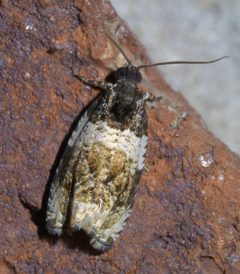
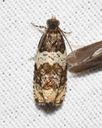
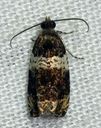
Olethreutes fasciatana is a small tortricid found in eastern and central North America. are active in early summer with a wingspan of approximately 15 mm. The larvae are known to feed on willow (Salix) and poplar (Populus) , making this a herbivore on these woody plants.
Pronunciation
How to pronounce Olethreutes fasciatana: /oʊlɛθˈruːtiːz fæʃiəˈtænə/
These audio files are automatically generated. While they are not always 100% accurate, they are a good starting point.
Identification
Distinguishing Olethreutes fasciatana from other Olethreutes requires examination of genitalia or detailed wing pattern analysis; available sources do not provide field identification characters. The Olethreutes contains numerous similar small tortricid moths, many requiring determination.
Images
Appearance
Small with wingspan of approximately 15 mm. exhibit the typical tortricid resting posture with wings held roof-like over the body. Specific coloration and pattern details are not well documented in available sources.
Habitat
Associated with containing plants Salix and Populus , which include riparian areas, wetlands, and wooded landscapes. Specific habitat preferences beyond host plant presence are not documented.
Distribution
Recorded from Alabama, Illinois, Maryland, Massachusetts, New Jersey, New York, North Carolina, Ohio, Oklahoma, Pennsylvania, Vermont, and Wisconsin in the United States. The range appears to cover eastern and parts of central North America.
Seasonality
have been recorded in June. Larval is not documented.
Diet
Larvae feed on Salix and Populus . feeding habits are not documented.
Host Associations
- Salix - larval food plantwillow
- Populus - larval food plantpoplar
Ecological Role
As a herbivore on Salix and Populus, the larvae contribute to nutrient cycling in riparian and wetland . The may serve as prey for and other natural enemies, though specific interactions are not documented.
Similar Taxa
- Other Olethreutes speciesNumerous congeneric in this large share similar size and general , requiring careful examination for identification.
More Details
Taxonomic history
Originally described as Exartema fasciatana by Clemens in 1860, later transferred to the Olethreutes.
Data limitations
This has received limited study; most information derives from specimen records and basic natural history observations rather than dedicated research.