
Hedya nubiferana
(Haworth, 1811)
marbled orchard tortrix, green budworm moth
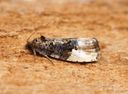
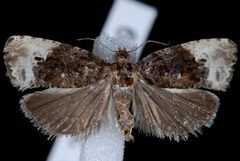
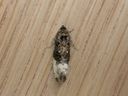
Hedya nubiferana is a small tortricid with a wingspan of 15–21 mm, characterized by distinctive forewing markings including a square basal black spot and a prominent white cross-band at the wing tip. The occurs across the Palearctic and Nearctic realms. are active from May to August in western Europe, with timing varying across the range. Larvae develop on hawthorn (Crataegus) and blackthorn (Prunus spinosa).
Pronunciation
How to pronounce Hedya nubiferana: /ˈhɛd.jə njuː.bɪˈfɛː.rə.nə/
These audio files are automatically generated. While they are not always 100% accurate, they are a good starting point.
Identification
Distinguished from similar Hedya by the combination of a square (not rounded) basal black spot and the broad white cross-band on the forewing. The white band has been likened to bird droppings, a possible form of protective mimicry. The light-grey cross-band between the basal spot and wing tip provides additional diagnostic separation from .
Images
Habitat
Associated with shrubland and woodland edge supporting larval plants, particularly hawthorn and blackthorn thickets. Occurs in both rural and semi-urban environments where these shrubs are present.
Distribution
Palearctic and Nearctic realms. Recorded across Europe including Belgium, with confirmed presence in Antwerpen, Brussels-Capital, Flemish, and Walloon regions. North American distribution extends the range into the Nearctic.
Seasonality
period May to August in Belgium and the Netherlands; timing varies across the broader range.
Diet
Larvae feed on hawthorn (Crataegus ) and blackthorn (Prunus spinosa). feeding habits not documented.
Host Associations
- Crataegus - larval foodplanthawthorn
- Prunus spinosa - larval foodplantblackthorn
Life Cycle
Larval development occurs on shrubs. Specific details of placement, larval instars, site, and stage not documented in available sources.
Ecological Role
Larval herbivore on Rosaceae shrubs; specific ecological functions such as pollination or position not documented.
Human Relevance
"green budworm " and association with fruit trees suggests potential minor economic concern in orchards, though specific damage assessments are not documented. Frequently recorded in citizen science platforms with over 4500 iNaturalist observations.
Similar Taxa
- Other Hedya speciesShare general forewing pattern elements but differ in shape of basal spot (square vs. rounded) and width/position of pale cross-bands
More Details
Protective coloration
The prominent white forewing band has been interpreted as resembling bird droppings, potentially functioning as disruptive camouflage against visual .