
Eumarozia malachitana
(Zeller, 1875)
Sculptured Moth
Eumarozia malachitana, commonly known as the sculptured , is a small tortricid moth with a wingspan of 11.5–16 mm. It is widely distributed across eastern North America, with records extending from Ontario and Maine south to Florida and west to Texas and Oklahoma. The exhibits activity, with periods in July and from September to October. Larvae are known to feed on a diverse range of plants including woody species and some cultivated plants.
Pronunciation
How to pronounce Eumarozia malachitana: /juːˌmɑːroʊˈziːə ˌmæləkɪˈtɑːnə/
These audio files are automatically generated. While they are not always 100% accurate, they are a good starting point.
Identification
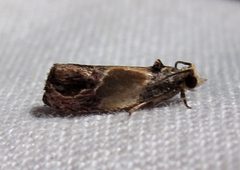
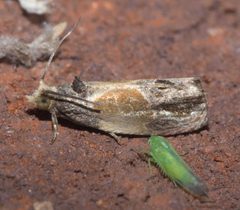
The small size (wingspan under 16 mm) and specific timing (July, September–October) may aid identification within the diverse Tortricidae . The 'sculptured ' implies distinctive wing patterning, but diagnostic features for separating this from are not documented in available sources.
Images
Appearance
Small with wingspan 11.5–16 mm. The epithet 'malachitana' and 'sculptured moth' suggest patterned or textured wing markings, though specific coloration details are not provided in available sources.
Distribution
Eastern North America, with records from: Alabama, Arkansas, California, Florida, Georgia, Illinois, Indiana, Iowa, Kentucky, Louisiana, Maine, Maryland, Massachusetts, Minnesota, Mississippi, Missouri, New Jersey, North Carolina, Ohio, Oklahoma, Ontario (Canada), Pennsylvania, South Carolina, Tennessee, Texas, Vermont, Virginia, and West Virginia. The California record appears anomalous relative to the otherwise eastern distribution.
Seasonality
are active in July and from September to October, indicating two per year ().
Diet
Larvae feed on: Ostrya virginiana (American hophornbeam), Diospyros virginiana (American persimmon), Pyrus communis (common pear), Cassia , Gomphrena species, and Manilkara species. This range spans woody trees, fruit crops, and ornamental plants.
Host Associations
- Ostrya virginiana - larval food plantAmerican hophornbeam, a native deciduous tree
- Diospyros virginiana - larval food plantAmerican persimmon, native to eastern North America
- Pyrus communis - larval food plantCommon pear, cultivated fruit tree
- Cassia - larval food plant of leguminous plants
- Gomphrena - larval food plant of flowering plants including globe amaranth
- Manilkara - larval food plant of tropical trees including sapodilla
Life Cycle
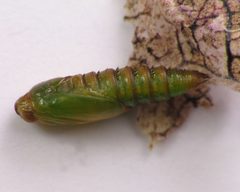
with two periods. Specific details regarding , larval, and pupal stages are not documented in available sources.
Ecological Role
As a herbivore with larvae feeding on both native trees and cultivated plants, the may function as a minor agricultural pest on pear and potentially other crops, while also contributing to nutrient cycling in natural forest .
Human Relevance
Potential minor pest of pear (Pyrus communis). Otherwise not of significant economic or medical importance.
Similar Taxa
- Other Eumarozia speciesCongeneric likely share similar size and general ; precise identification requires examination of genitalia or detailed wing pattern analysis
- Other small OlethreutinaeMany tortricid moths in this are similar in size and general appearance, making field identification challenging without specialized knowledge
More Details
Nomenclatural history
Originally described as Grapholitha malachitana by Zeller in 1875, later transferred to Eumarozia.
Geographic note
The California record in source data appears inconsistent with the otherwise exclusively eastern North American distribution and may represent a misidentification, vagrant individual, or introduced .
Observation frequency
Over 4,000 observations documented on iNaturalist, indicating the is frequently encountered and photographed by naturalists within its range.