
Coptotriche aenea
(Frey, 1873)
Blackberry Leafminer Moth
Coptotriche aenea is a small in the Tischeriidae, commonly known as the Blackberry Leafminer Moth. The is known for its larval habit of mining leaves of Rubus species, particularly blackberries. It is widely distributed across eastern and central North America, with records from Canada through the eastern United States to Texas and Oklahoma.
Pronunciation
How to pronounce Coptotriche aenea: //ˌkɒptəˈtraɪki ˈeɪnɪə//
These audio files are automatically generated. While they are not always 100% accurate, they are a good starting point.
Identification
Distinguished from other Tischeriidae by the bronze forewing coloration and specific larval association with Rubus. The leaf mines are diagnostic: larvae create irregular blotch mines on the upper surface of blackberry leaves, with the mine expanding as the larva grows. may require genitalia examination for definitive identification from similar Coptotriche .
Images
Appearance
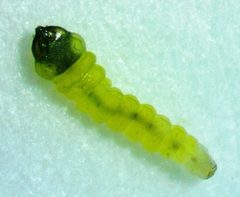
are small with a wingspan typically under 10 mm. The forewings are bronze to golden-brown (aenea = bronze-colored) with distinctive patterning. The hindwings are narrower and paler. Larvae are minute, legless that create characteristic blotch mines in leaves.
Habitat
Found in areas supporting its plants, primarily Rubus . include woodland edges, hedgerows, old fields, and disturbed areas where blackberries and related brambles grow.
Distribution
Eastern and central North America: Nova Scotia and Ontario in Canada; in the United States from Connecticut and New Jersey south to Florida, west to Arkansas, Oklahoma, and Texas, with records from Ohio, Pennsylvania, West Virginia, Kentucky, Mississippi, and the District of Columbia.
Diet
Larvae feed internally in leaves of Rubus (blackberries, raspberries, and related brambles), creating blotch mines. do not feed; their mouthparts are non-functional.
Host Associations
- Rubus - larval plantleaf-mining on blackberries and related brambles
Life Cycle
Complete with , larva, pupa, and stages. Larvae mine leaves of Rubus , feeding between the upper and lower . occurs within the mine or in soil. Multiple per year likely in southern portions of range; specific poorly documented.
Behavior
Larvae are sedentary leaf miners, feeding in place within the leaf. are likely or ; they have reduced mouthparts and do not feed.
Ecological Role
As a , larvae create localized damage to Rubus leaves. The is a herbivore with no known significant economic or ecological impact.
Human Relevance
Minor potential as a pest of cultivated blackberries and raspberries, though damage is generally insignificant. More commonly encountered by entomologists studying leaf-mining insects than by agriculturalists.
Similar Taxa
- Other Coptotriche speciesSimilar size and ; require genitalia examination or larval association for separation
- Other TischeriidaeSimilar leaf-mining habit; distinguished by plant and mine
More Details
Taxonomic Note
The specific epithet 'aenea' refers to the bronze coloration of the forewings.
Leaf Mine Characteristics
Larval mines begin as linear tracks and expand into irregular blotches as the larva grows. is deposited within the mine.