
Astrotischeria solidagonifoliella
Clemens, 1859
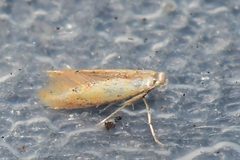
A small leaf-mining in the Tischeriidae, described by James Brackenridge Clemens in 1859. The larvae create distinctive mines in leaves of goldenrod (Solidago) . The species occurs across eastern North America.
Pronunciation
How to pronounce Astrotischeria solidagonifoliella: //ˌæstroʊˌtɪʃəˈrɪə ˌsɒlɪˌdæɡoʊnɪˌfoʊliˈɛlə//
These audio files are automatically generated. While they are not always 100% accurate, they are a good starting point.
Identification
Larvae are identified by their serpentine or blotch mines in Solidago leaves, with deposited in characteristic patterns. are small requiring microscopic examination for definitive identification; they lack the more prominent wing patterns seen in some related Tischeriidae.
Images
Habitat
Associated with goldenrod in open including meadows, fields, roadsides, and forest edges.
Distribution
Eastern North America, from Oklahoma and North Carolina north to Quebec and Manitoba.
Diet
Larvae feed on Solidago (goldenrods), mining the mesophyll of leaves.
Host Associations
- Solidago - larval Multiple Solidago are used as
Life Cycle
Larval stage consists of leaf-mining feeding within Solidago leaves. likely occurs in the soil or leaf litter, though specific details are not well documented.
Behavior
Larvae are endophagous leaf miners, feeding internally within leaf tissue and creating visible mines. are presumably or , typical for Tischeriidae.
Ecological Role
As a herbivore on Solidago, larvae contribute to leaf damage and nutrient cycling in goldenrod-dominated plant . They may serve as prey for and other natural enemies.
Human Relevance
No significant economic or medical importance. Occasionally encountered by botanists and entomologists studying leaf-mining insects or goldenrod .
Similar Taxa
- Other Astrotischeria speciesMany Astrotischeria are leaf miners on Asteraceae; precise identification requires examination of genitalia and plant association.
- Tischeria ekebladellaAlso a but on oak (Quercus) rather than Solidago; mine patterns and plant distinguish them.
More Details
Etymology
The specific epithet 'solidagonifoliella' derives from Solidago (the ) and 'folium' (leaf), referencing its association with goldenrod leaves.