
Xylesthia pruniramiella
Clemens, 1859
Clemens' Bark Moth

Pronunciation
How to pronounce Xylesthia pruniramiella: //zaɪˈlɛsθiə ˌpruːnɪræmiˈɛlə//
These audio files are automatically generated. While they are not always 100% accurate, they are a good starting point.
Identification
Images
Appearance
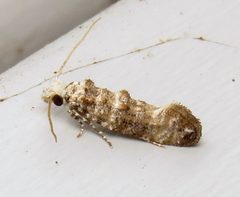
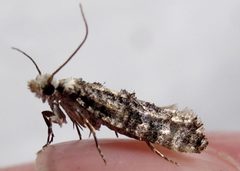
Small with wingspan 12.7–13.7 mm. Forewings are blackish brown and luteous brown, variably marked with whitish patches. Distinctive features include patches of elevated at the wing base and along the fold, an indistinct whitish band crossing the middle of the disc, a fainter band nearer the base, and another band near the end of the disc. A white spot appears at the inner angle with an adjacent whitish streak from the above it, plus an additional whitish costal streak between this and the tip. The wing tip has a blackish spot with white margin. Hindwings are dark brown with slight reddish tinge.
Habitat
Associated with plum trees (Prunus spp.), specifically where woody excrescences occur on branches. details beyond tree presence are not documented.
Distribution
Eastern and central North America, recorded from New Hampshire south to Florida and west from Illinois to Texas. Also recorded from the Galápagos Islands (presence status).
Seasonality
active from February to December, with year-round period possible.
Diet
Larvae feed on woody excrescences (abnormal growths) found on branches of plum trees (Prunus spp.). diet not documented.
Host Associations
- Prunus - larval woody excrescences on branches
Life Cycle
Complete with larval stage specialized on woody growths of plum branches. Specific details of , pupal stages, and time are not documented.
Ecological Role
Larval feeding on woody excrescences may contribute to nutrient cycling on trees; specific ecological impacts are not documented.
Human Relevance
No significant documented economic or cultural importance. Not known as a pest of commercial plum production.
Similar Taxa
- Other Xylesthia speciesSimilar size and general Tineidae ; distinguished by specific forewing pattern elements including elevated patches and banding arrangement
- Other small TineidaeMany Tineidae are small with mottled brown forewings; the distinctive patches and specific whitish marking pattern of X. pruniramiella aid separation
More Details
Etymology
Specific epithet 'pruniramiella' derives from Latin: pruni- (plum) + rami (branch) + diminutive suffix -ella, referencing the larval association with plum tree branches.