
Monopis spilotella
(Tengström, 1848)
Orange-headed monopis
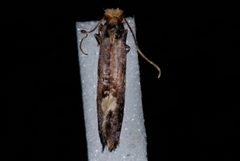
Monopis spilotella is a small tineid described by Tengström in 1848. The has a transcontinental distribution spanning northern Eurasia and North America. are active during the summer months with a period extending from May through September. The species is known by the Orange-headed monopis.
Pronunciation
How to pronounce Monopis spilotella: //mɔˈnoʊ.pɪsˌspaɪ.loʊˈtɛl.ə//
These audio files are automatically generated. While they are not always 100% accurate, they are a good starting point.
Identification
The combination of small size (10–19 mm wingspan), orange coloration, and summer period (May–September) may help distinguish this from other Monopis. However, specific diagnostic features separating M. spilotella from are not documented in available sources. Genitalia examination may be required for definitive identification.
Images
Appearance
Small with a wingspan of 10–19 mm. The 'Orange-headed monopis' suggests distinctive orange coloration on the region.
Distribution
Northern Europe: Scandinavia, Denmark, Baltic region, Ukraine, and Russia. North America: recorded from Canada (Alberta, Manitoba, Saskatchewan).
Seasonality
are on wing from May to September.
Similar Taxa
- Other Monopis speciesThe Monopis contains multiple small tineid moths with similar size ranges; M. spilotella is distinguished by its orange coloration and specific geographic distribution pattern spanning both Palearctic and Nearctic regions.
More Details
Taxonomic history
Originally described as Tinea spilotella by Tengström in 1848, later transferred to Monopis. The has been recorded in GBIF with distribution records from Finland and Canadian provinces (Alberta, Manitoba, Saskatchewan).
Observation data
iNaturalist records 767 observations for this , indicating it is moderately well-documented by citizen scientists.