
Monopis marginistrigella
(Chambers, 1873)
White-blotched Monopis Moth
Monopis marginistrigella is a small in the Tineidae, commonly known as the White-blotched Monopis Moth. The was described by Chambers in 1873 and belongs to a whose larvae are known to feed on animal detritus, including feathers, fur, and dead insects. are and attracted to light. The species has been documented primarily in the northeastern United States.
Pronunciation
How to pronounce Monopis marginistrigella: /məˈnoʊpɪs ˈmɑrdʒɪnɪstrɪˈɡɛlə/
These audio files are automatically generated. While they are not always 100% accurate, they are a good starting point.
Identification
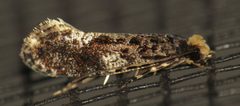
The white blotch on the forewing distinguishes this from other Monopis species, which generally lack such a prominent pale marking. M. marginistrigella may be confused with M. pavlovskii, but the latter has more uniformly dark forewings without the contrasting pale patch. Genitalia examination may be required for definitive identification in some cases.
Images
Appearance
are small with wingspan approximately 10-15 mm. Forewings are mottled brown with a distinctive white or pale blotch near the , giving rise to the . Hindwings are narrow and pale grayish. The body is slender with a tufted .
Habitat
Associated with wooded and semi-open where larval food resources accumulate. have been observed in deciduous forest edges, suburban areas, and near buildings where organic debris collects.
Distribution
Documented from the northeastern United States, with records from Vermont and surrounding regions. The full range may extend more broadly in eastern North America, but precise boundaries remain unclear due to limited survey effort and potential confusion with .
Seasonality
have been recorded from late spring through summer, with peak activity likely in June and July. Specific data are limited.
Diet
Life Cycle
Complete with , larval, pupal, and stages. Larvae construct silken tubes or cases incorporating debris. Developmental timing and number of per year are not well documented for this specifically.
Behavior
are and attracted to artificial light sources. Larvae are scavengers that feed within protective silken shelters.
Ecological Role
Decomposer that contributes to nutrient cycling by breaking down animal-derived organic matter, particularly keratin and that few other organisms can digest.
Human Relevance
Occasionally found indoors where it may be attracted to light or enter through open windows. Not considered a significant pest; larvae do not damage woolens or stored products to the extent of some related Tineidae .
Similar Taxa
- Monopis pavlovskiiSimilar size and general appearance, but lacks the white forewing blotch characteristic of M. marginistrigella; genitalia differ
- Monopis laevigellaEuropean with uniformly brown forewings without contrasting pale markings; not known to overlap in range but may be confused in reference collections
More Details
Taxonomic note
The specific epithet marginistrigella refers to the marginal streak or stripe on the forewing, though the most prominent feature is actually the pale blotch rather than a dark streak.