Monopis longella
(Walker, 1863)
Pavlovski's Monopis Moth
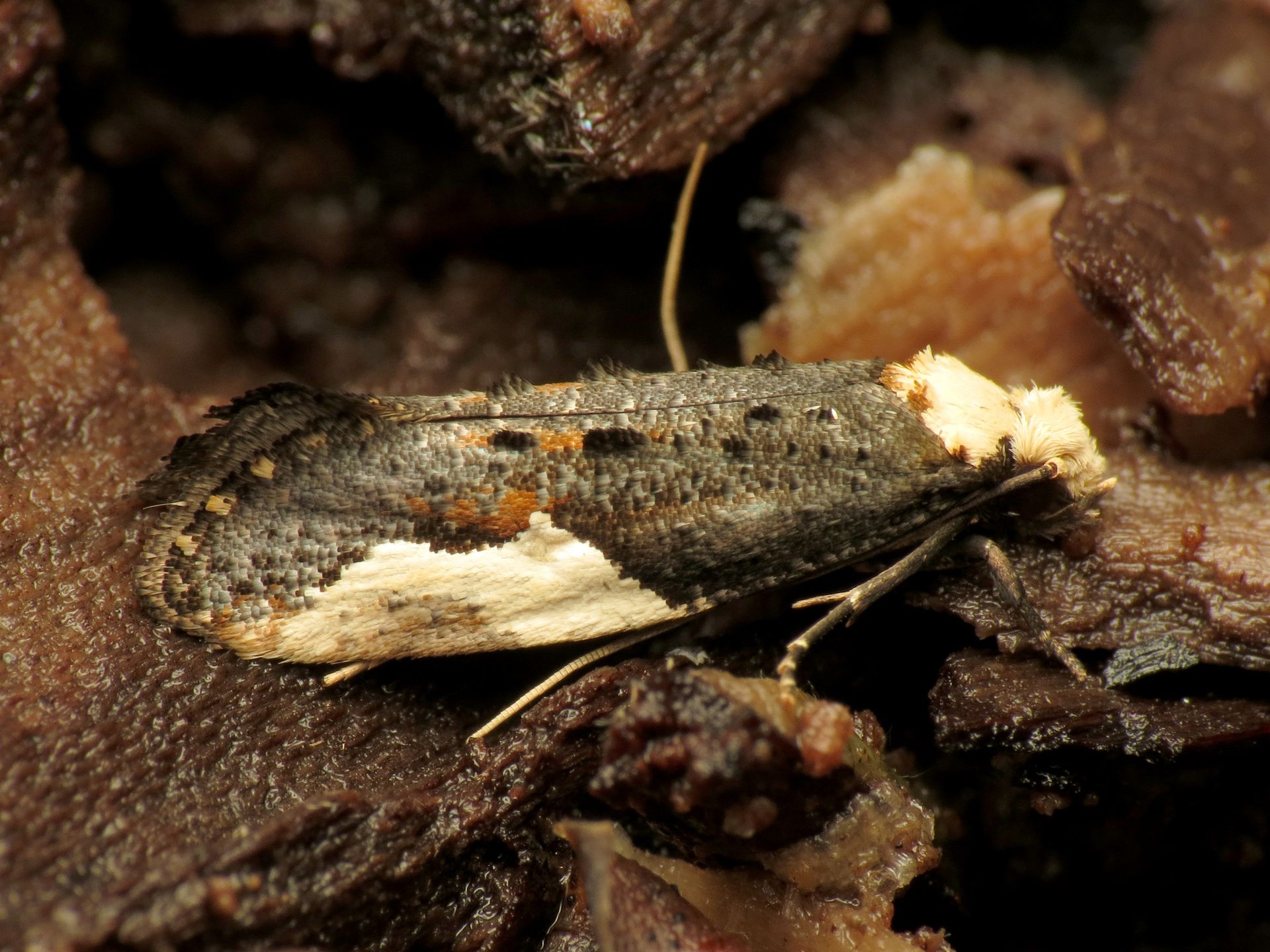
Monopis longella is a tineid with a broad Palearctic and Oriental distribution, now established as an introduced in eastern North America. Its larvae construct tubular tunnels in bird nests where they feed on keratinous materials. The species is notable for a distinctive mitochondrial arrangement that differs from typical lepidopteran patterns.
Pronunciation
How to pronounce Monopis longella: //mɒˈnəʊ.pɪs lɒŋˈdʒɛl.ə//
These audio files are automatically generated. While they are not always 100% accurate, they are a good starting point.
Images
Habitat
Larvae inhabit tubular tunnels constructed within bird nests. have been collected in open environments including Jeollanam-do Province, South Korea.
Distribution
Native range: China, Korea, Japan, Russia (Far East), India, Pakistan, Thailand, Malaysia, Philippines, and Vietnam. Introduced and established in North America from New York south to central Florida and west to Michigan, with records from Vermont.
Diet
Animal hair and feathers.
Host Associations
- birds - Larvae construct tunnels in bird nests
Life Cycle
Larval stage occurs in tubular tunnels within bird nests. documented in South Korea (Jeollanam-do Province). Complete developmental timeline not documented.
Human Relevance
Introduced in North America; established from New York to Florida and west to Michigan. No documented economic or health impacts.
Similar Taxa
- Tineola bisselliellaClosely related within Tineidae based on phylogenetic analysis of mitochondrial ; both are keratin-feeding nest inhabitants
More Details
Mitochondrial genome
The complete mitochondrial is 15,541 and exhibits a unique gene arrangement among Lepidoptera, specifically a trnI-trnM-trnQ sequence in the A+T-rich region and at the ND2 junction. Uses ATT as the COI start rather than the typical CGA found in most Lepidoptera.