
Psychinae
Boisduval, 1829
bagworm moths
Genus Guides
6- Astala(bagworm moth)
- Basicladus
- Cryptothelea
- Eucoloneura
- Hyaloscotes
- Psyche(bagworm moths)
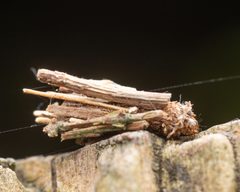
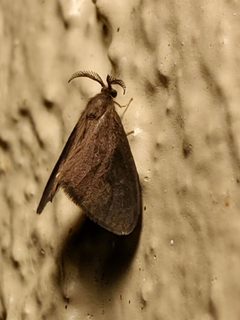
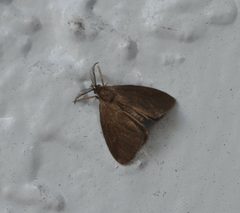
Psychinae is a of bagworm moths within the Psychidae, established by Boisduval in 1829. The subfamily comprises at least 12 . Members are characterized by the construction of portable protective cases from silk combined with plant material, soil particles, or other debris. Larval case-building is the defining trait of this group. males are usually winged, while females are often wingless and remain in their cases.
Pronunciation
How to pronounce Psychinae: /ˈsaɪkaɪniː/
These audio files are automatically generated. While they are not always 100% accurate, they are a good starting point.
Identification
Distinguished from other Psychidae by case and larval , though specific diagnostic features require examination of genitalia and wing venation in . Male genitalia structure and wing scaling patterns are used in taxonomic separation. Larval cases of Psychinae tend to be more uniform and less decorated than those of some related subfamilies. Females must be identified by association with males or through molecular methods due to their reduced morphology.
Images
Appearance
males possess fully developed wings and are capable of ; females are frequently or brachypterous, with reduced or absent wings. Body size varies among . Larvae construct distinctive cylindrical or tapered cases from silk secretions reinforced with environmental materials including twigs, leaves, bark fragments, or sand grains. Case architecture and material composition vary by and availability. Adults generally exhibit muted coloration—browns, grays, or blacks—providing camouflage against bark and detritus.
Habitat
Occupies diverse terrestrial environments including forests, woodlands, scrublands, and occasionally urban green spaces. Larval is determined by plant distribution. Cases are attached to vegetation, rocks, or structures during feeding and . Moisture availability affects case construction materials and larval survival.
Distribution
distribution with representation across temperate, subtropical, and tropical regions. Documented from North America, Europe, Asia, Africa, and Australia. Specific range boundaries vary by and .
Seasonality
timing varies by latitude and ; generally active during warmer months in temperate zones. Some species exhibit with synchronized adult periods; others may be multivoltine in favorable climates. Larval cases persist year-round and may be found in stages during winter.
Life Cycle
Holometabolous development with , larva, pupa, and stages. Larvae are the primary feeding and growing stage, remaining within portable cases that are enlarged through successive instars. occurs within the larval case, which is sealed at both ends. Females of many do not exit their cases as adults, releasing to attract males for mating directly at the pupal case. Males emerge to seek females.
Behavior
Larvae drag their cases while foraging, anchoring them with silk during feeding and rest. Case construction is a continuous throughout larval development, with materials selected from the immediate environment. Males exhibit positive anemotaxis in response to female . Females remain within cases after in many .
Ecological Role
Larvae function as herbivores or depending on , consuming living plant tissue or decaying plant matter. Cases contribute to nutrient cycling when abandoned or following . Serve as prey for birds, , and other . Some species may reach pest status in forestry or horticulture when are high.
Human Relevance
Occasional economic significance as defoliators of ornamental trees and shrubs, particularly conifers. Larval cases are sometimes mistaken for plant galls or seeds by observers. Used in ecological studies as indicators of environmental quality due to their sensitivity to pollution and disturbance. Some have been investigated for silk protein properties.
Similar Taxa
- EpichnopteriginaeAnother Psychidae with case-building larvae; distinguished by differences in male genitalia structure and larval case architecture, with Epichnopteriginae cases often more irregularly constructed.
- OiketicinaePsychidae containing some economically important pest ; separation based on and larval case characteristics, with Oiketicinae often showing more specialized associations.
- TaleporiinaeRelated Psychidae ; differs in larval case construction patterns and wing , particularly in female expression.
More Details
Taxonomic composition
Contains 12 recognized according to current classifications, though generic boundaries and assignments remain subject to revision based on molecular phylogenetic studies.
Sexual dimorphism
Extreme is a hallmark of the , with females of many exhibiting complete aptery and neotenic retention of larval characteristics, while males develop normal structures for .