
Banisia myrsusalis
(Walker, 1859)
sapodilla borer, sapota midrib folder
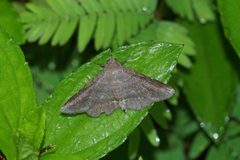
Banisia myrsusalis is a small in the Thyrididae, described by Francis Walker in 1859. It is widely distributed across tropical and subtropical regions including the Americas, Africa, Asia, and Australia. The is known for its association with sapodilla and related trees, where larvae fold leaf midribs and mine tissues. are distinguished by greyish-brown wings with linear dark striations and yellow costal margins.
Pronunciation
How to pronounce Banisia myrsusalis: //bəˈnɪziə maɪrsuːˈsælɪs//
These audio files are automatically generated. While they are not always 100% accurate, they are a good starting point.
Identification
Distinguished from similar Thyrididae by combination of small size (2 cm wingspan), greyish-brown ground color with linear dark striations, yellow forewing , and contrasting cilia coloration (fuscous forewing, white hindwing). The two brownish postmedial patches and single sub- patch on forewings provide additional diagnostic characters. Distinguished from Banisia by geographic distribution and subtle pattern variations where ranges overlap.
Images
Appearance
Small with wingspan approximately 2 cm. Body greyish brown, occasionally with slight red or pink tinge. Wings linearly striated with dark brown; forewing yellow. Cilia fuscous on forewing, white on hindwing. surface silvery grey with prominent and chestnut brown coloration. Forewings display two brownish postmedial patches and one sub- patch. Palpi with moderately long third joint. nearly simple in both sexes. Outer margins of both wings evenly curved.
Habitat
Tropical and subtropical regions associated with plants in Sapotaceae. Found in agricultural settings, orchards, and natural forests where Manilkara zapota and related occur.
Distribution
North America, Brazil, Australia, southern Asia (India, Sri Lanka), Africa (Madagascar, South Africa, Democratic Republic of the Congo, Republic of the Congo, Côte d'Ivoire, Ghana, Kenya).
Diet
Larvae feed on leaves of Sapotaceae: Manilkara zapota (sapodilla), Mimusops elengi, Pouteria caimito, Madhuca latifolia, and Terminalia tomentosa. do not feed.
Host Associations
- Manilkara zapota - larval primary , sapodilla
- Mimusops elengi - larval
- Pouteria caimito - larval
- Madhuca latifolia - larval
- Terminalia tomentosa - larval
Life Cycle
Total approximately 40.8 ± 3.97 days for males and 45.35 ± 4.08 days for females under experimental conditions. Larval stage involves folding leaf midribs and mining leaf tissues.
Behavior
Larvae fold leaf midribs and create mines in leaves of plants. are .
Ecological Role
Herbivore specializing on Sapotaceae; larval feeding damages leaves of economically important fruit trees, particularly sapodilla.
Human Relevance
Pest of sapodilla (Manilkara zapota) orchards in tropical regions. Larval feeding on leaves reduces photosynthetic capacity and can affect fruit production. Subject of agricultural research on seasonal and varietal susceptibility.
Similar Taxa
- Other Banisia speciesSimilar wing pattern and size; distinguished by specific markings, geographic range, and associations where known
- Other Thyrididae members share general body plan and wing venation; Banisia myrsusalis distinguished by small size, striated wing pattern, and yellow
More Details
Subspecies
Three recognized: Banisia myrsusalis cinereola Felder, Felder & Rogenhofer, 1875; Banisia myrsusalis elaralis (Walker, 1859); Banisia myrsusalis sumatrensis Whalley, 1976. Subspecies elaralis has been specifically studied as a pest of sapota in India.