
Aglossa electalis
Hulst, 1886
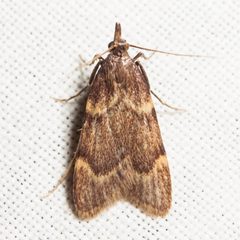
Aglossa electalis is a snout moth in the Pyralidae, first described by George Duryea Hulst in 1886 (though sometimes cited as 1866). It is to California, United States. The species has a wingspan of approximately 27 mm. It belongs to the Aglossa, which contains several species commonly known as grease due to their association with stored organic materials.
Pronunciation
How to pronounce Aglossa electalis: //əˈɡlɒsə ɛˌlɛkˈteɪlɪs//
These audio files are automatically generated. While they are not always 100% accurate, they are a good starting point.
Identification
Distinguished from other Aglossa by geographic restriction to California combined with the 27 mm wingspan measurement. Accurate identification to species level within Aglossa typically requires examination of genitalia or detailed wing pattern analysis; the is known for morphological similarity among species.
Images
Appearance
Wingspan approximately 27 mm. As a member of the snout moth Pyralidae, possess elongated labial palps that project forward from the , creating a characteristic 'snout' appearance. Specific coloration and wing pattern details for A. electalis are not well documented in available sources.
Distribution
to California, United States. Specific preferences within this range are not documented in available sources.
Similar Taxa
- Other Aglossa speciesMorphologically similar; require detailed examination or geographic context to distinguish. Several Aglossa overlap in general appearance and size.
- Pyralidae (snout moths) in generalShared characteristics including elongated labial palps and body form; -level or -level identification requires closer inspection.
More Details
Nomenclatural note
The description date is cited as 1886 in authoritative sources (Catalogue of Life, GBIF) though Wikipedia states 1866; the 1886 date appears to be correct based on taxonomic databases.
Data limitations
Despite 94 iNaturalist observations, detailed biological information (, diet, , ) appears sparse in published literature for this .